


A New Window Into the Cosmos
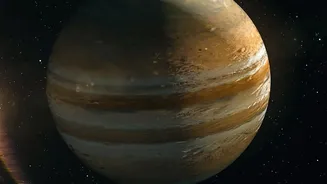
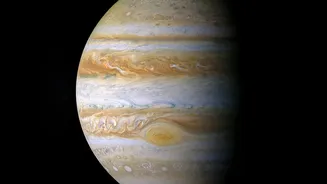
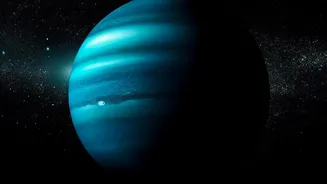
For decades, studying the atmospheres of exoplanets—planets outside our solar system—was like trying to read a book from a kilometre away. We knew they were there, but the details were blurry. Gas giants, especially a class known as 'hot Jupiters', orbit
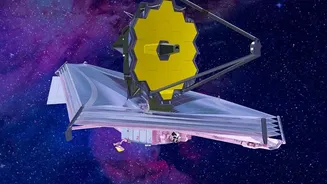
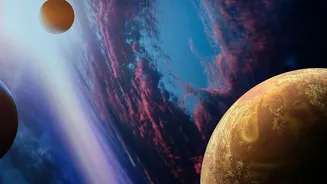
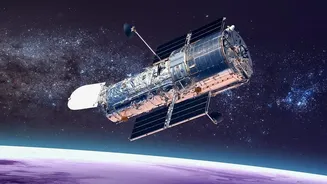
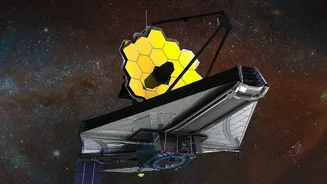
incredibly close to their stars, making them searingly hot and tidally locked, meaning one side perpetually faces the star's heat while the other is in permanent darkness. This creates extreme conditions, but their sheer distance made it nearly impossible to observe weather patterns directly. Previous telescopes like Hubble could detect hints of water or haze, but a clear picture remained elusive. This all changed with the advent of powerful infrared observatories, most notably the James Webb Space Telescope (JWST). By analysing infrared light, which is essentially heat, astronomers can now do more than just detect a planet; they can dissect its atmosphere layer by layer.
The Science of Starlight
The primary technique is called transmission spectroscopy. As an exoplanet passes in front of its host star, a tiny fraction of the starlight filters through the planet's atmosphere. Different gas molecules absorb specific wavelengths, or colours, of light. By looking at which colours are missing from the starlight that reaches the telescope, scientists can create a chemical fingerprint of the atmosphere, identifying elements like water, carbon dioxide, and methane. Another method, called eclipse mapping, measures the faint infrared glow of the planet itself. By tracking the changes in brightness as the planet orbits and disappears behind its star, researchers can construct a temperature map of its surface, revealing hot spots and cooler regions across its different faces. This has allowed for the creation of the first-ever 3D temperature maps of these distant worlds.
Weather That Defies Imagination
So, what has this new technology revealed? The weather on these gas giants is more extreme than we could have imagined. On WASP-43 b, a hot Jupiter 280 light-years away, ferocious equatorial winds blow at over 5,000 miles per hour, circulating heat from the scorching dayside to the cooler nightside. The dayside reaches temperatures of nearly 1,250 degrees Celsius, hot enough to forge iron, while the nightside is a comparatively cooler 600 degrees Celsius. More recent studies on a planet named WASP-94A b have uncovered a bizarre daily cloud cycle. Its mornings are blanketed in thick clouds made not of water, but of magnesium silicate—the same stuff rocks are made of. By evening, as the atmosphere heats up, these rock clouds completely evaporate, leaving the skies clear. This discovery of a repeating weather pattern on an exoplanet is a monumental first.
Unravelling the Story of Planet Formation
Mapping these atmospheres isn't just about cosmic meteorology; it provides crucial clues about how these planets were born and evolved. The composition of a gas giant's atmosphere, particularly the ratio of heavier elements to hydrogen and helium, tells a story. For instance, the atmosphere of exoplanet HD149026b was found to be surprisingly rich in heavy elements, far more than a planet of its mass should have based on the models from our own solar system. This suggests that giant planets across the galaxy form in a wide variety of ways, challenging our previous assumptions. By studying the abundance of molecules like carbon dioxide, scientists can determine how much solid versus gaseous material went into a planet's formation, offering a glimpse into the chaotic early days of distant solar systems.