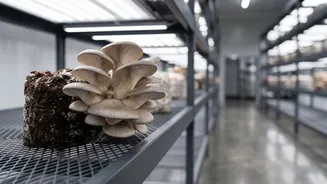







What is a Mushroom Micro-Factory?
Forget traditional farms. A mushroom micro-factory is a form of Controlled Environment Agriculture (CEA), often housed in a shipping container, warehouse, or even a basement. Inside, every element crucial for growth—temperature, humidity, airflow, and
light—is precisely managed. This high-tech approach uses automated systems, sensors, and vertical shelving to create the perfect conditions for mushrooms to flourish, year-round, regardless of the weather outside. Unlike plants, mushrooms don't need sunlight or soil, making them uniquely suited for these indoor, space-saving setups. This technology transforms mushroom cultivation from a seasonal practice into a consistent, predictable, and highly efficient production line for fresh food.
The Eco-Friendly Advantage
One of the most powerful arguments for micro-factories is their minimal environmental footprint. Firstly, they are masters of recycling. Mushrooms thrive on agricultural byproducts that would otherwise be waste, such as sawdust, coffee grounds, and straw from wheat or paddy. This turns organic waste into a valuable nutrient source, creating a circular economy where very little is thrown away. Secondly, these systems are incredibly water-efficient, using significantly less water than many traditional crops because moisture is recirculated within a closed loop. Finally, by growing food directly within cities, these factories slash transportation distances from farm to consumer. This reduces the carbon emissions associated with long-haul logistics and ensures consumers get fresher produce.
Designed for Urban Scalability
The term 'micro-factory' points to its key strength: modularity. These units are designed to be stacked, combined, or multiplied based on demand, allowing for easy and rapid scaling. An entrepreneur can start with a single container farm and add more units as their business grows, reducing initial investment risk. Because they rely on vertical space, with mushrooms grown on stacked shelves, the yield per square foot can be incredibly high. This is a game-changer in dense urban areas where land is expensive and scarce. A small, forgotten warehouse or an unused lot can be transformed into a productive food hub, demonstrating a level of scalability that is impossible for land-intensive conventional farming.
A Perfect Fit for Indian Metros
For rapidly growing metros across India, mushroom micro-factories offer a compelling solution to several challenges. They provide a reliable, local source of nutritious food, enhancing urban food security and reducing dependence on strained supply chains. This model also has economic benefits, creating local jobs in cultivation, processing, and distribution right within the city. With a variety of mushrooms like oyster, button, and milky mushrooms suited to different Indian climates, the model is highly adaptable. By bringing production closer to home, it reduces food spoilage during transit and gives consumers access to produce that is hours, not days, old. It's a system that supports local economies, promotes healthier diets, and builds more resilient cities.
Challenges on the Horizon
Despite the promise, the path to widespread adoption has its hurdles. The initial setup cost for a fully automated, climate-controlled container can be significant, potentially creating a barrier for small-scale entrepreneurs. These high-tech farms also rely on a consistent supply of electricity to power the systems that control temperature, humidity, and airflow, which can be a challenge in some areas. Success requires not just the right technology but also technical knowledge of mycology to manage the entire process from substrate preparation to harvesting, preventing contamination, and optimizing yields. As the technology becomes more accessible and awareness grows, these challenges can be overcome, paving the way for a new wave of urban farmers.