




The Challenge of Cloudy Days
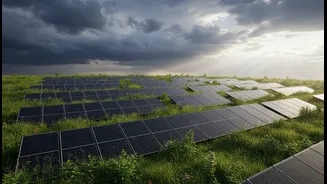
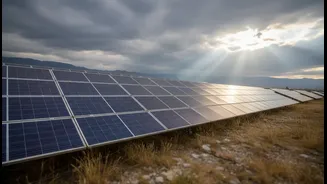
India has made massive strides in solar energy, with vast solar farms and rooftop panels becoming a common sight. However, the country's reliance on the sun comes with a significant challenge: seasonal inconsistency. During the monsoon season, which can last
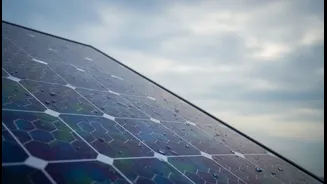
for months, heavy cloud cover drastically reduces the output of conventional solar panels. This is because traditional panels, typically made from silicon, are optimised for direct, bright sunlight. When clouds scatter that light, creating what is known as diffuse light, the efficiency of these panels drops significantly, sometimes by as much as 90% on heavily overcast days. This variability can be a major headache for grid stability and makes solar a less reliable power source during certain times of the year.
Enter Perovskite and Tandem Cells
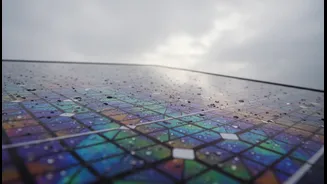
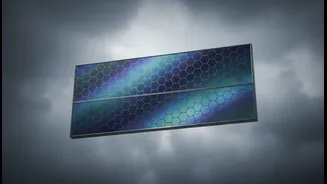
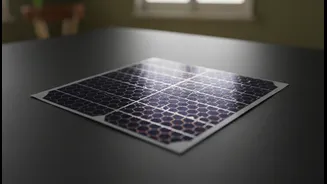
Scientists are tackling this problem by developing new types of solar materials, with a class of materials called perovskites leading the charge. Perovskites have a unique crystal structure that is exceptionally good at absorbing light. Unlike silicon, which has a fixed bandgap, the properties of perovskites can be 'tuned' to absorb different wavelengths of light more effectively. This makes them particularly adept at capturing energy from the ambient and diffuse light common on cloudy days or even indoors. Some of the most exciting research involves creating 'tandem' solar cells. These stack a semi-transparent perovskite layer on top of a traditional silicon layer. The top perovskite layer captures high-energy visible light, while allowing lower-energy infrared light to pass through to the silicon layer below, essentially getting two chances to convert light from a wider spectrum into electricity.
How They Outperform in Low Light
The secret to this low-light success lies in physics. Because perovskite cells can be engineered to have an ideal bandgap for indoor or diffuse light, they can convert these weaker light sources into electricity with surprising efficiency. In lab settings, while conventional silicon cells perform best under the full sun, some perovskite cells have shown dramatically higher power conversion efficiency under low-light conditions, sometimes outperforming their silicon counterparts by a significant margin in such environments. Think of it this way: a standard solar panel is like a specialist sprinter who is fastest in perfect conditions, while a perovskite or tandem cell is more like a versatile all-rounder who performs consistently across different terrains and weather. This ability to harvest energy from scattered photons is what makes them a potential game-changer for regions with frequent cloud cover.
What This Means for India
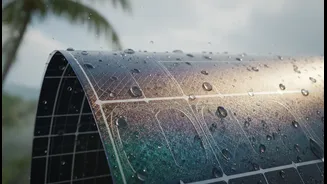
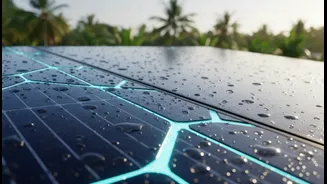
For India, a technology that ensures more consistent solar generation during the monsoon could be revolutionary. It would mean a more stable and reliable renewable energy supply year-round, reducing dependence on fossil fuels to back up the grid when the sun isn't shining brightly. States in the Northeast and coastal areas, which experience heavy and prolonged monsoons, could particularly benefit, unlocking their solar potential in ways that are currently challenging. Furthermore, as rainfall often cleans the dust and grime off panels—another major issue impacting efficiency—panels that also work well in wet, cloudy weather could provide a double benefit. Some research is even exploring hybrid panels that can generate a small amount of electricity from the impact of raindrops, though this is still highly experimental.
The Road Ahead: Hurdles to Overcome
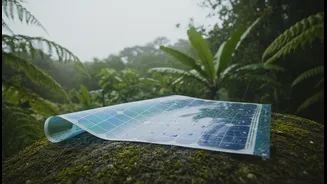
While the promise is immense, it's important to remember that this technology is still largely in the research and development phase. The biggest challenges for perovskite solar cells are durability and scalability. Early versions of these materials tended to degrade when exposed to moisture and heat—a significant issue in a country like India. While recent breakthroughs have led to more stable and durable designs, proving their long-term viability over 20-25 years, like silicon panels, is the next major hurdle. Furthermore, scaling up production from lab prototypes to large, commercially viable solar panels at a competitive cost is a massive industrial challenge that researchers and companies are actively working to solve.