

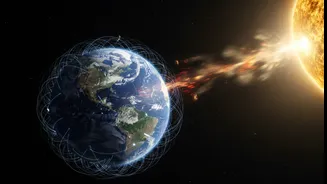
Understanding the Threat From 93 Million Miles Away
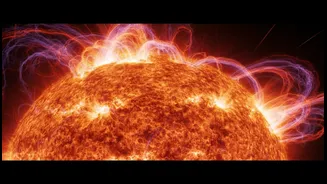
The primary threats from the sun are solar flares and coronal mass ejections (CMEs). A solar flare is an intense burst of radiation that can reach Earth in about eight minutes, potentially causing high-frequency radio blackouts on the sun-facing side
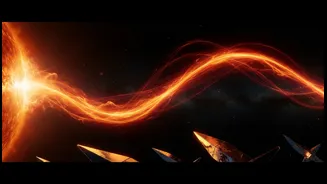
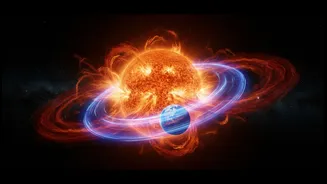
of the planet. A CME is a much larger eruption, a colossal cloud of magnetised plasma and charged particles that travels through space. While slower, taking anywhere from one to three days to arrive, a CME that hits Earth can trigger a geomagnetic storm. This disturbance of our planet's protective magnetic field can induce powerful currents in long conductors on the ground, like power lines and pipelines, potentially causing widespread blackouts and damaging critical infrastructure. The infamous 1989 blackout in Quebec, which left six million people without power for nine hours, was caused by such a storm.
Our Eyes on the Sun
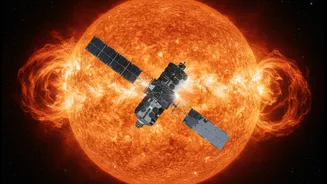
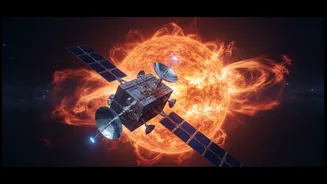
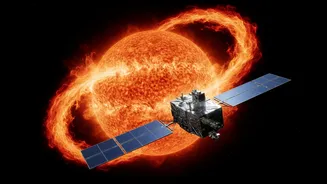
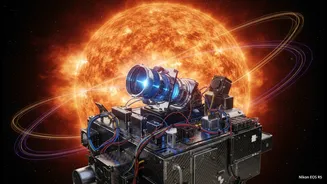
To get ahead of these events, scientists rely on a fleet of vigilant spacecraft that monitor the sun 24/7. Satellites like NASA’s Solar Dynamics Observatory (SDO) and the joint NASA/ESA Solar and Heliospheric Observatory (SOHO) provide constant, high-definition images of the sun in various wavelengths of light. This allows forecasters to spot active regions, such as sunspots, where the sun's tangled magnetic fields are more likely to snap and release energy. Further out, at a gravitationally stable point between the Sun and Earth called Lagrange Point 1 (L1), the Deep Space Climate Observatory (DSCOVR) satellite acts as a crucial tripwire. It directly measures the solar wind—the stream of charged particles constantly flowing from the sun—giving scientists a vital one-hour heads-up before a CME's blast wave strikes Earth.
From Data to Forecast
All this raw data streams back to Earth, where it’s fed into sophisticated computer models at centres like the US National Oceanic and Atmospheric Administration’s (NOAA) Space Weather Prediction Center (SWPC). The SWPC is the official source for space weather alerts and warnings for the United States, operating jointly with the U.S. Air Force. Forecasters there analyse the real-time satellite imagery and solar wind data to determine the size, speed, and direction of any eruption. Using models like the Wang-Sheeley-Arge (WSA)-Enlil, they can predict if a CME is heading toward Earth and estimate its arrival time and potential intensity. This process transforms millions of data points into actionable intelligence, categorised on scales that are easy to understand, similar to how hurricanes are classified.
Putting the Warning to Work
When the SWPC issues a watch or a warning, a race against time begins for various industries. Power grid operators are among the most critical users of these forecasts. An impending geomagnetic storm gives them time to take protective measures. This might involve rerouting power, bringing extra generation capacity online to ensure voltage stability, or postponing non-essential maintenance. In extreme cases, they might intentionally disconnect certain sensitive equipment to prevent catastrophic damage to transformers, which can be difficult and time-consuming to replace. Satellite operators also take action, sometimes powering down non-essential electronics or reorienting their spacecraft to protect sensitive components from damaging energetic particles. Airlines might reroute flights away from polar regions, where the Earth's magnetic field offers less protection from solar radiation and where communication disruptions are more common during a storm.
The Future of Space Weather Preparedness
The field of space weather forecasting is constantly evolving. Scientists are developing new models and leveraging artificial intelligence to analyse the vast amounts of solar data more quickly and accurately than ever before. New missions, like NOAA’s Space Weather Follow On-Lagrange 1 (SWFO-L1), are designed to succeed aging satellites and provide even higher-quality data to improve warning times and forecast accuracy. At the same time, engineers are designing more resilient infrastructure on the ground. This includes installing devices known as neutral blocking devices, which can physically block the harmful geomagnetically induced currents from flowing into and damaging large power transformers. This combination of better forecasting and stronger infrastructure is our best defence against the sun's inevitable fury.