



A Sugar Found Among the Stars
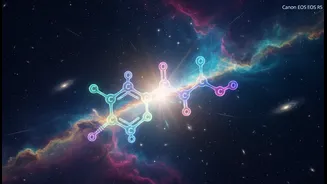
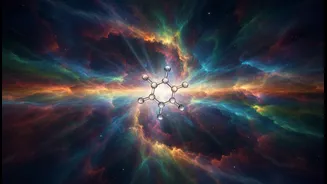
In a breakthrough for astrobiology, an international team of scientists has identified erythrulose, a four-carbon sugar, floating in a gas cloud near the center of our Milky Way galaxy. The discovery was made using powerful radio telescopes in Spain,
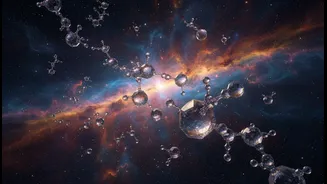
which detected the specific radio signature of the molecule in a region known as G+0.693-0.027. While sugars have been found in meteorites that have landed on Earth, this is the first time a true sugar has been directly detected in the interstellar medium—the raw material from which stars and planets are born. On Earth, erythrulose is found in raspberries, but its presence thousands of light-years away is far more significant. It suggests that the chemical processes in the universe are capable of creating complex, biologically relevant molecules even before planets form.
Why This Discovery Is a Game-Changer
Sugars are one of the fundamental pillars of life as we know it. They serve as energy sources and, most critically, form the structural backbone of RNA and DNA, the molecules that carry genetic instructions in all living things. A major puzzle in origin-of-life research is how these essential sugars first formed on the early Earth, as laboratory simulations suggest they would not have been produced in sufficient quantities. The detection of erythrulose in space provides a compelling answer: the ingredients for life may not have needed to form on Earth at all. Instead, they could have been delivered to our young planet by comets and meteorites that were seeded with these molecules in interstellar space. This finding supports the theory of an exogenous, or extraterrestrial, origin for some of life's key building blocks.
The Cosmic Chemical Factory
The molecular cloud where erythrulose was found is a cold, dense clump of gas and dust. Far from being empty, these clouds act as vast chemical factories. On the surfaces of icy dust grains, simple atoms and molecules can combine, powered by cosmic radiation, to form much more complex structures. What makes the erythrulose discovery particularly surprising is its complexity and abundance. Scientists found that this four-carbon sugar is at least eight times more abundant than any simpler three-carbon sugars in the same cloud. This challenges the long-held theory that complex molecules are built up slowly, one carbon atom at a time, and suggests that more efficient formation pathways exist in the interstellar medium, perhaps by combining two-carbon molecules.
A Stepping Stone to RNA
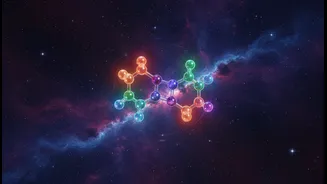
Erythrulose is what chemists call a C4 sugar, meaning it has four carbon atoms. While not directly used in DNA or RNA, it is a crucial precursor. Scientists note that in water-based environments, erythrulose can readily change into threose, a molecule that is part of a simpler nucleic acid system (TNA) believed to be a possible evolutionary predecessor to RNA. The discovery of a molecule so closely linked to the building blocks of genetic systems is a massive leap forward. It demonstrates that the pathway to molecules like ribose—the five-carbon sugar that forms the backbone of RNA—is potentially viable in interstellar conditions.
The Future of Prebiotic Chemistry
This discovery opens a new frontier in astrobiology. Researchers will now be looking for even more complex sugars and other prebiotic molecules in these stellar nurseries. A key next step will be to determine the 'chirality' or 'handedness' of these interstellar molecules. Many important biological molecules, including sugars and amino acids, exist in left-handed or right-handed forms, yet life on Earth almost exclusively uses one version. Finding a preference for one form over the other in space could help explain this fundamental biological mystery. The detection of erythrulose is a powerful confirmation that the universe is seeded with the ingredients for life. It strengthens the possibility that life might not be a rare accident confined to Earth, but a common outcome of cosmic chemistry throughout the galaxy.