



More Than Just a Six-Pack
First, it's important to redefine what a 'strong core' really means. It’s not just about the rectus abdominis, the muscle responsible for a visible 'six-pack'. A functional core is a complex system of muscles that wraps around your entire torso, including
your back, obliques, pelvic floor, and diaphragm. This muscular network acts as a stabilizing corset for your spine and pelvis. Its job is to provide stability for every move you make, from carrying groceries to maintaining good posture at your desk. Unlike exercises that isolate one muscle, yoga teaches these groups to work together as a unified system.
The Science of Stillness
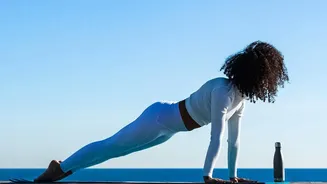
Holding a yoga pose is a form of isometric exercise, where muscles are contracted without changing their length or moving the joints. Think of holding a Plank: your muscles are working intensely to resist gravity and maintain a static position. This sustained contraction, or 'time under tension', builds muscular endurance and strength in the deep stabilizing fibres that are often missed in dynamic exercises. This process increases muscle tension, and upon release, a rush of blood flows back, which can help blood vessels relax and may even contribute to lower blood pressure over time. This quiet effort is incredibly effective at building stability, which is the foundation of functional strength.
Plank Pose (Phalakasana)
The Plank is a fundamental pose for a reason. It is considered a functional core exercise because it requires so many muscles in the core, shoulders, and arms to work together at once. To perform it correctly, start on your hands and knees, then step your feet back until your body forms a straight line from head to heels. Engage your abdomen as if tightening a belt around your waist. It is crucial to prevent your hips from sagging or your ribs from dropping toward the floor. If a full plank is too intense, you can modify it by placing your forearms on the ground or dropping your knees to the mat.
Boat Pose (Navasana)
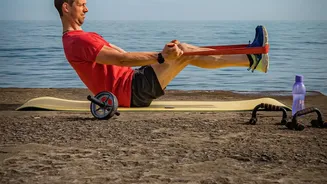
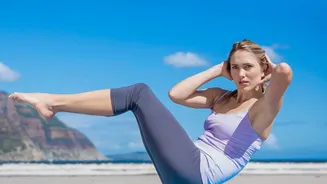
Boat Pose is a highly efficient core strengthener because it engages the abs, hip flexors, back, and pelvic muscles all at once. To get into the pose, sit on the floor with your knees bent. Lean back slightly, keeping your spine straight and chest lifted, and lift your feet until your shins are parallel to the floor. You can keep your hands on the floor behind you for support or extend them forward. For a greater challenge, straighten your legs to create a 'V' shape with your body. The key is to balance on your sit bones and use your core to prevent your lower back from rounding.
Bird-Dog Pose (Dandayamana Bharmanasana)
This beginner-friendly pose is excellent for building core stability because it trains your body to resist rotation. Start on your hands and knees in a tabletop position. Engage your core to keep your back flat and your hips level. Extend your right arm forward and your left leg straight back simultaneously. Hold for a few breaths, focusing on keeping your torso completely still without tilting. Slowly lower back down and repeat on the other side. This movement teaches the deep abdominal and lower back muscles to work together to keep the spine steady.
Bridge Pose (Setu Bandhasana)
While often thought of as a backbend or glute exercise, Bridge Pose is also a fantastic gentle core strengthener. The muscles of your lower back and glutes are an integral part of your core's posterior chain. To practice, lie on your back with your knees bent and feet flat on the floor, hip-width apart. On an exhale, press through your feet to lift your hips off the floor. Your abdominals work to stabilize your pelvis and support your lower back. Hold the position, continuing to breathe steadily, engaging not just your glutes but also the muscles that support your spine.