


A Day Longer Than A Year
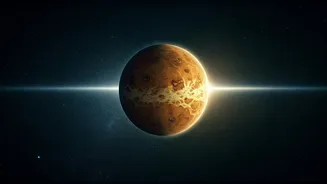
On Earth, our daily and yearly cycles are comfortably distinct. Our planet spins on its axis once every 24 hours, giving us a day, and orbits the Sun once every 365 days, giving us a year. Venus completely upends this logic. A year on Venus—the time it takes
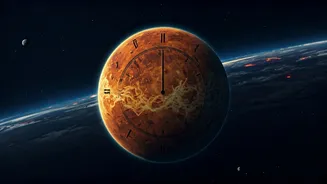
to complete one orbit around the Sun—is about 225 Earth days. But a single day on Venus, measured by the time it takes for the planet to complete one full rotation on its axis, is approximately 243 Earth days. This means a Venusian day is about 18 Earth days longer than its year. If you could stand on its surface, you would complete a full trip around the Sun before the planet itself has even finished spinning once. This fundamental oddity is the starting point for understanding why Venus is often called Earth’s ‘twisted sister’.
Spinning The Wrong Way
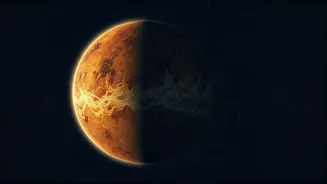
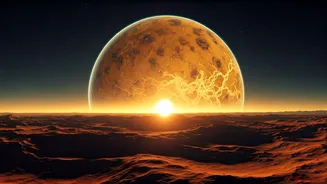
Adding to the weirdness is Venus’s rotation. Nearly every planet in our solar system, including Earth, spins on its axis in a counter-clockwise direction (prograde motion). This is why we see the Sun rise in the east and set in the west. Venus, however, spins clockwise. This is known as retrograde rotation. If you were on Venus, the Sun would appear to rise in the west and set in the east. Only one other planet, Uranus, shares this backward spin, though it’s tilted so far on its side it’s almost rolling along its orbit. Scientists aren’t entirely sure why Venus spins the wrong way, but the leading theory involves a colossal impact. It’s believed that early in its history, Venus was struck by a massive planet-sized object that not only reversed its spin but also slowed it down to the incredibly sluggish pace we observe today.
The Solar Day Paradox
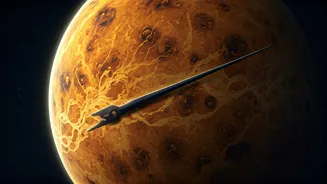
Here's where it gets even more mind-bending. While a full rotation (a sidereal day) takes 243 Earth days, the time from one sunrise to the next (a solar day) is different. Because the planet is slowly rotating backward while also moving forward in its orbit around the Sun, the time it takes for the Sun to return to the same point in the sky is much shorter. A solar day on Venus is about 117 Earth days long. So, while a single spin takes forever, you’d experience roughly two sunrises and sunsets for every Venusian year. This creates a bizarre calendar where the year is shorter than the rotational day but longer than the solar day. It’s a concept that challenges our Earth-centric understanding of time.
An Atmosphere on Fast-Forward
The planet’s slow rotation has a dramatic effect on its weather. While the solid planet itself barely moves, its thick, toxic atmosphere is a different story. The upper clouds of Venus, made mostly of sulfuric acid, are in a state of ‘super-rotation’. Winds whip around the planet at speeds up to 360 kilometres per hour, circling the entire globe in just four to five Earth days. This means the atmosphere is lapping the planet’s surface about 60 times for every single rotation. Scientists are still working to understand the mechanics driving this super-rotation, but it creates a violent and dynamic weather system high above a surface that is otherwise rotating at a walking pace.
Why Is Venus So Strange?
Venus and Earth are similar in size, mass, and composition, yet they evolved into vastly different worlds. Earth is a temperate haven for life, while Venus is a hellscape with surface temperatures hot enough to melt lead and crushing atmospheric pressure. Understanding its strange rotation is key to unlocking the secrets of its past. Was it the ancient impact that sent it down a different evolutionary path? Or were other factors at play? Upcoming missions, like NASA’s VERITAS and DAVINCI+, aim to map Venus’s surface and sample its atmosphere in unprecedented detail. By studying our bizarre neighbour, scientists hope to better understand not just how planets form and evolve, but also what makes a planet like Earth so uniquely habitable.