


The Old Rules of the Solar System
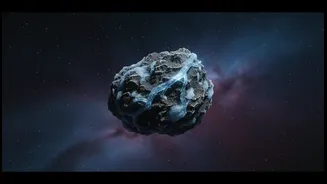
For generations, the difference between an asteroid and a comet was simple. Asteroids are the rocky, inert bodies that mostly live in the main asteroid belt, a vast ring of debris between the orbits of Mars and Jupiter. They are cosmic potatoes, quietly
orbiting the Sun without much drama. Comets, on the other hand, are the dramatic visitors from the cold, dark outer reaches of the solar system. Composed of ice, dust, and rock, they are often called 'dirty snowballs'. When their long, looping orbits bring them close to the Sun, the heat causes their ices to turn directly into gas—a process called sublimation—creating a glowing halo (a coma) and a magnificent tail that can stretch for millions of kilometres. One group lives in the relatively warm inner solar system; the other comes from the frigid outskirts. One is quiet, the other is active. These were the clear categories astronomers worked with.
A Surprise in the Asteroid Belt
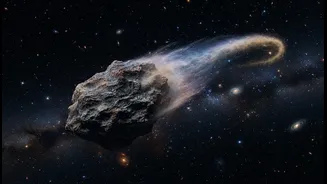
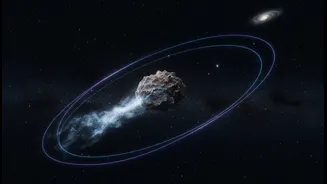
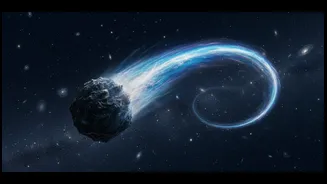
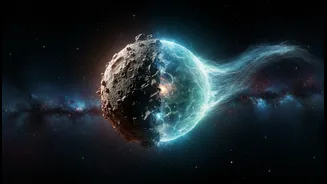
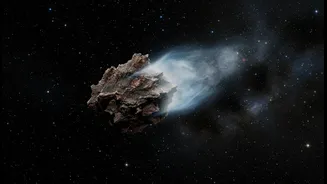
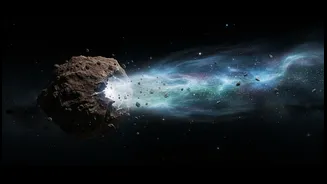
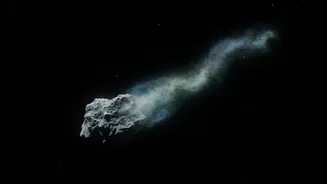
This neat division was disrupted by an object known as (248370) 2005 QN173. First discovered in 2005, it was classified as a standard, unremarkable asteroid orbiting within the main belt. For years, it behaved exactly as expected. But then, observations made by the Asteroid Terrestrial-impact Last Alert System (ATLAS) survey revealed something astonishing: the supposedly inactive asteroid had sprouted a tail. This wasn't just a small puff of dust; it was an enormous, narrow tail stretching over 720,000 kilometres long—nearly twice the distance from the Earth to the Moon. Suddenly, an object with the address of an asteroid was displaying the signature feature of a comet. It was a cosmic identity crisis, and astronomers were eager to understand why.
What's Causing the Tail?
Unlike tails caused by a collision or the asteroid spinning so fast it sheds material, the activity of 2005 QN173 appears to be recurrent. Further investigation of archival images showed that the asteroid also had a tail during a previous close approach to the Sun in 2016. This repeating behaviour strongly suggests that the tail is being created by the same process that drives comets: the sublimation of ice. This implies that, despite living in the comparatively warm asteroid belt, 2005 QN173 must have reservoirs of ice hidden beneath its rocky surface. As it gets closer to the Sun in its orbit, this buried ice heats up, turns to gas, and escapes, dragging dust particles along with it to form the long, thin tail.
A New Class of Celestial Object
This object is not entirely alone. It belongs to a recently recognised and rare class of bodies that scientists are calling 'active asteroids' or 'main-belt comets'. These are objects that have the stable, near-circular orbits of asteroids but exhibit the comet-like activity of venting gas and dust. Fewer than 30 such objects have been confirmed, making each new discovery incredibly valuable. They challenge our understanding because, according to older models of the solar system, any ice in the main asteroid belt should have sublimated away billions of years ago. Finding objects that are still active suggests that water ice might be more common in the inner solar system than previously thought, perhaps preserved in subterranean pockets.
Why This Blurry Line Matters
The existence of these hybrid objects is more than just a cosmic curiosity. It has profound implications for our understanding of the history of the solar system and even the origin of life on Earth. Scientists have long theorised that water was delivered to our young, dry planet by impacts from icy bodies. For a long time, comets from the outer solar system were the prime suspects. However, chemical analysis of those comets doesn't perfectly match the water in Earth's oceans. The discovery of icy asteroids in the main belt provides a new, closer-to-home candidate for the source of Earth's water. These active asteroids are like time capsules, offering clues about the distribution of water and other volatile materials during the era when the planets were forming. By studying them, we can refine our models of planetary formation and better understand the ingredients that made Earth a habitable world.