






2001: A Space Odyssey (1968)
To start anywhere else would be a disservice to cinematic history. Stanley Kubrick's masterpiece is less a movie and more a transcendent visual symphony. Long before the advent of digital effects, Kubrick and his team pioneered techniques that still leave
modern audiences breathless. The film's depiction of space is famously grounded in scientific accuracy, with its silent, slow-moving spacecraft and meticulously designed interiors. Practical effects, like the intricate models and the groundbreaking 'Stargate' sequence created with slit-scan photography, were revolutionary. Kubrick insisted on capturing effects 'in camera' to avoid any degradation of quality, resulting in images of astonishing clarity. From the iconic 'Dawn of Man' sequence to the mysterious monolith and the psychedelic journey beyond the infinite, '2001' uses its visuals to ask profound questions about humanity's place in the universe. It’s a meditative, often silent, epic where the spectacle itself is the story.
Gravity (2013)
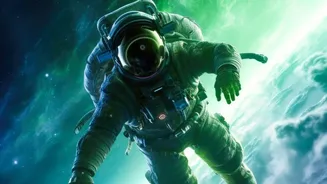
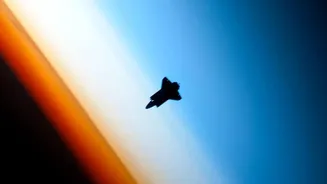
If '2001' showed the philosophical majesty of space, Alfonso Cuarón’s 'Gravity' captured its terrifying, visceral reality. The film is a masterclass in tension, largely thanks to its revolutionary visual effects, which swept the Oscars and Visual Effects Society Awards. Cuarón and cinematographer Emmanuel Lubezki created a seamless blend of live-action and CGI, inventing new technology to do so. The film’s legendary opening shot, an uninterrupted 13-minute take, immerses the audience completely in the zero-gravity environment, making you feel every moment of Dr. Ryan Stone's fight for survival. By using long, floating camera movements, the film conveys the disorienting nature of space where there is no up or down. The visual storytelling is so powerful that you feel the cold, silent vacuum and the breathtaking beauty of the Earth from orbit, making it an intensely personal and overwhelmingly immersive big-screen event.
Interstellar (2014)
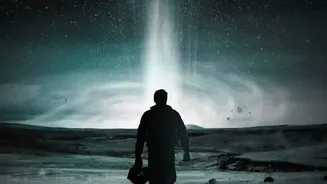
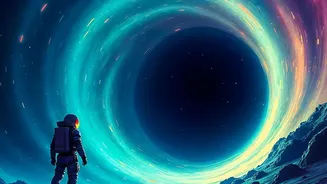
Christopher Nolan is a director famously devoted to in-camera realism, and 'Interstellar' is his grandest love letter to practical filmmaking. This epic journey through a wormhole to save humanity is as much about real science as it is science fiction. Nolan worked with theoretical physicist Kip Thorne to ensure the film's depiction of black holes and wormholes was scientifically accurate, leading to new scientific models. Rather than relying on green screens, the team projected ultra-high-resolution images of space onto massive screens around the sets, allowing the actors to react to real environments and the camera to capture the reflections on their helmet visors. The result is a tactile, believable universe. The scale is immense, from the dust-choked landscapes of a dying Earth to the colossal tidal waves on a distant water planet and the awe-inspiring sight of the black hole, Gargantua. It’s a film that earns its epic scope through a combination of big ideas and even bigger visuals.
Dune (2021)
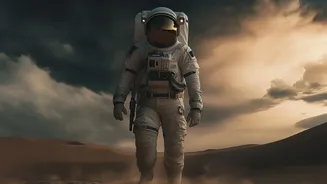
Denis Villeneuve’s adaptation of Frank Herbert’s sprawling novel is a masterwork of world-building and scale. From the very first frame, 'Dune' establishes a universe that feels ancient, immense, and lived-in. The film's visual language is defined by its brutalist architecture and sheer, jaw-dropping size. Gigantic sandworms, colossal spaceships, and vast, windswept deserts on the planet Arrakis are rendered with a photorealistic, tangible quality that makes them feel utterly real. Cinematographer Greig Fraser captures these epic vistas with the eye of a landscape painter, emphasizing the insignificance of humans against the backdrop of powerful natural and political forces. Every shot is meticulously composed to convey a sense of weight and history, from the ornate interiors of the Atreides palace to the harsh, sun-bleached Fremen sietches. 'Dune' isn't just an adaptation; it's a sensory immersion into another world, designed to overwhelm and humble the viewer with its sheer, breathtaking scale.