








The Legend of the Seven Pagodas
The magnificent Shore Temple at Mahabalipuram, a UNESCO World Heritage site, stands as a solitary sentinel on the coast of the Bay of Bengal. But according to folklore and the accounts of early European sailors, it was not always alone. The legend speaks
of a magnificent city with seven glittering pagodas, six of which were claimed by the sea in a great deluge, an event some scholars now speculate could have been a tsunami in the 13th century. For generations, local fishermen have passed down stories of glimpsing submerged walls and carved stones during their voyages, keeping the tantalising possibility of a lost city alive. These tales, for the longest time, blurred the line between myth and history.
A Modern Quest Begins
The 2004 Indian Ocean tsunami, a tragedy of immense scale, inadvertently provided a stunning clue. As the waters receded momentarily from the Mahabalipuram coast, onlookers reported seeing a long line of large stone structures emerge from the seabed before being swallowed again by the waves. This dramatic eyewitness event galvanised the scientific community. The Archaeological Survey of India (ASI) and the National Institute of Oceanography (NIO) launched expeditions, marking the first serious, technology-driven efforts to systematically investigate these submerged mysteries. The initial surveys, conducted in the early 2000s, did indeed find compelling evidence of man-made structures beneath the waves.
The Sonar and ROV Revolution
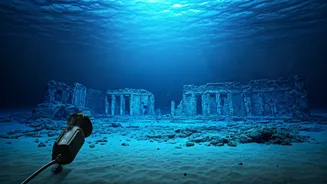
While early explorations relied on sonar and diver investigations, the latest phase of exploration represents a significant technological leap. After a pause of nearly two decades, the ASI's Underwater Archaeology Wing resumed its studies in 2025, armed with advanced tools. The headline technology is a Remotely Operated Vehicle (ROV). This unmanned submersible can navigate challenging deep-water environments, capturing high-resolution video and images without disturbing the delicate seabed. This is the “sonar revolution” in action: combining sonar to map the seafloor and identify anomalies, and then deploying ROVs for close-up, non-invasive visual inspection. This approach offers unprecedented precision and safety, allowing archaeologists to document findings in remarkable detail.
What Lies Beneath the Waves?
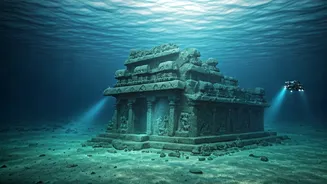
The results have been extraordinary, gradually turning myth into documented reality. Joint expeditions by the NIO and ASI over the years have confirmed the existence of submerged walls, some stretching over 10 metres, flights of stairs, and platforms made of dressed stone blocks at depths of 5 to 8 metres. Some discoveries include walls with multiple courses, chiselled stone blocks, and features that strongly suggest they were part of a larger temple complex. While a complete city has not been uncovered, the evidence points to a significant, planned settlement that existed and was eventually submerged. The findings confirm that the area around the Shore Temple was once far more extensive. Radiocarbon dating of samples from some of the underwater ruins suggests that structures may have been submerged at different times, with some dating as far back as the first century.
Piecing Together an Ancient Puzzle
The discoveries off Mahabalipuram are about more than just finding lost temples; they are about rewriting the history of this ancient port city. The Pallava dynasty, who ruled during the 7th and 8th centuries, presided over a thriving maritime hub that traded with Southeast Asia and beyond. The underwater structures—whether they are the legendary pagodas or parts of a sprawling port complex—offer physical proof of the scale of this coastal activity. Each new finding, from a carved stone to a wall alignment, is a piece of a vast historical puzzle. Scientists believe the submergence was likely caused by a combination of factors over centuries, including sea-level rise and coastal erosion.