




An Unusual Space Rock
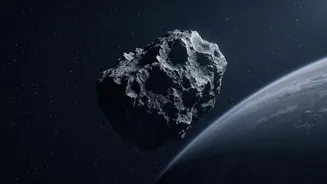
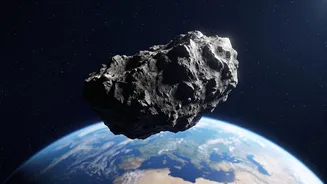
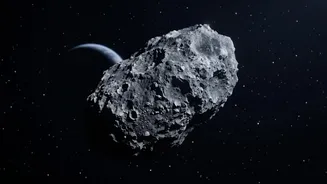
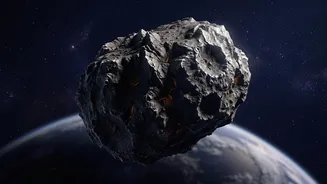
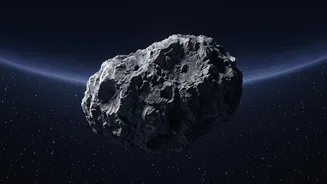
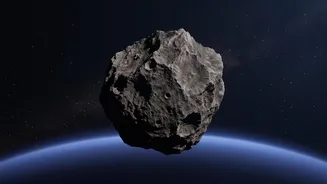
First spotted in 1998, 1998 KY26 is a near-Earth asteroid that is tiny even by asteroid standards. More recent observations in 2024 have revealed it's only about 11 metres wide, roughly the size of a small bus, and spins incredibly fast, completing a full
rotation in just over five minutes. This makes it one of the fastest-rotating objects known in our solar system. Due to its small size and proximity, it has become a target of great scientific interest, so much so that Japan's Aerospace Exploration Agency (JAXA) has directed its Hayabusa2 spacecraft to visit it, with an expected arrival in July 2031.
The Mystery of the Extra Push
The core of the puzzle lies in the asteroid's movement. Its trajectory shows a slight but persistent acceleration that cannot be explained by the gravitational pull of the Sun and planets alone. This 'non-gravitational' force is gently nudging the asteroid off its expected course. Such forces are not unheard of for small celestial bodies, but the specific cause for 1998 KY26 is the subject of a compelling scientific debate.
Theory 1: The Dark Comet Hypothesis
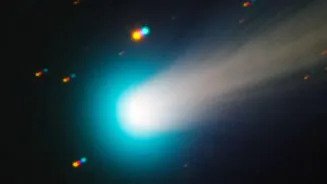
One leading theory proposed that 1998 KY26 might be a 'dark comet'. A regular comet develops a visible tail as its ice heats up near the Sun, turning into gas and dust that escapes into space. This process, known as outgassing, acts like a tiny rocket engine, creating a recoil force that pushes the comet. A dark comet is thought to be an object that still releases gas but so faintly that it doesn't produce a visible tail, making it look like an ordinary asteroid while still experiencing that extra push. This would neatly explain the mysterious acceleration.
Theory 2: A Gentle Nudge From Sunlight
An alternative explanation is a phenomenon known as the Yarkovsky effect. This occurs when an asteroid absorbs sunlight and re-radiates that energy back into space as heat. This emission of thermal photons creates a minuscule but constant thrust. Depending on the asteroid's direction of spin, this gentle push can either speed it up or slow it down, altering its orbit over millions of years. For a small, fast-spinning body like 1998 KY26, the Yarkovsky effect could be strong enough to account for the observed acceleration without needing any cometary activity.
Why It's Still A Puzzle
Recent research has cast doubt on the dark comet theory. A 2026 study from the Georgia Institute of Technology used thermal models to calculate the asteroid's temperature. The researchers concluded that 1998 KY26 is too warm to retain the buried water ice needed for outgassing. Their models suggest that any ice would have sublimated and vanished long ago, making a cometary push unlikely. However, these conclusions are based on simulations, not direct observation. The Yarkovsky effect remains a strong contender, but its exact influence is also difficult to prove without more data. There is even a fringe theory suggesting the object could be the lost Soviet spacecraft Phobos 1, though this is not widely accepted.
Why This Tiny Rock Matters
Figuring out what is pushing 1998 KY26 is about more than just solving a cosmic riddle. Understanding the nonstravitational forces that affect small asteroids is crucial for planetary defense. These subtle nudges can change an asteroid's path over time, making the difference between a nearmiss and a potential impact with Earth. By studying objects like 1998 KY26, scientists can refine their models for predicting asteroid trajectories, helping to keep our planet safe. The Hayabusa2 mission's rendezvous in 2031 promises to finally provide some concrete answers, turning this puzzle into a realworld laboratory for planetary science.