

A New Golden Age of Astronomy
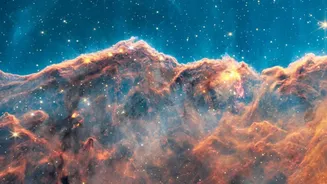
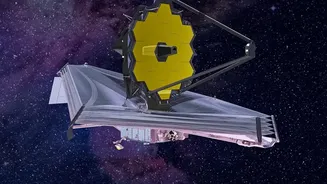
We are living in a new golden age of space observation. At the forefront is the James Webb Space Telescope (JWST), an observatory so powerful it’s fundamentally changing our view of the cosmos. Launched on Christmas Day 2021, JWST was designed to see
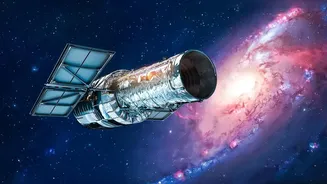
the universe in a way its celebrated predecessor, the Hubble Space Telescope, could not. While Hubble primarily sees visible and ultraviolet light, JWST is an infrared specialist. This is its superpower. Infrared light, which is invisible to the human eye, can pass through the dense clouds of cosmic gas and dust that hide celestial objects like newborn stars. It also allows astronomers to see light from the most distant galaxies, whose light has been stretched into the infrared spectrum by the expansion of the universe itself. With its massive 6.5-meter mirror, JWST can gather more light and peer deeper into time than any instrument before it.
Peering Back to Cosmic Dawn
One of JWST's primary missions is to find the very first stars and galaxies that formed after the Big Bang. Because light takes time to travel, looking at distant objects is like looking back in time. Webb is delivering on this promise, spotting galaxies that appear far more mature and structured than scientists expected for such an early era. Recently, astronomers have been studying mysterious objects from the early universe nicknamed "Little Red Dots". These could be primordial galaxies with supermassive black holes at their centers, forming much earlier than theories predicted. The discovery of these surprisingly advanced early galaxies is forcing scientists to rethink and refine models of cosmic evolution, showing that the universe’s first chapters may have unfolded differently than we thought.
The Secrets of Other Worlds
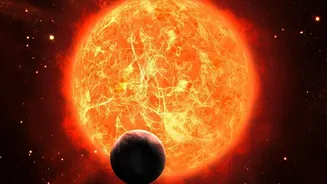
Beyond distant galaxies, modern telescopes are revolutionizing the study of exoplanets—planets orbiting other stars. The ability to analyze their atmospheres for chemical signatures is a major leap forward in the search for life. In a significant breakthrough, an atmosphere was detected around LHS 1140 b, a rocky, Earth-like planet located 48 light-years away in its star's habitable zone. This provides strong evidence that such worlds can hold onto their atmospheres for billions of years, a crucial ingredient for potential habitability. JWST is also pioneering new ways to find planets. Astronomers recently used it to discover a third planet, Beta Pictoris d, in a well-known system not by seeing its light directly, but by detecting the chemical fingerprint of its atmosphere. This spectroscopic method allows scientists to find worlds hidden in the glare of their star or dusty debris disks.
A Fleet of New Eyes
JWST isn't working alone. It's part of a fleet of next-generation observatories, each with unique strengths. The European Space Agency's Euclid telescope, which began its mission in 2023, is designed for wide-angle surveys. While JWST performs deep dives on specific targets, Euclid is mapping a third of the entire sky to create a vast 3D map of the cosmos. Its main goal is to understand the mysterious forces of dark matter and dark energy that govern the universe's expansion. Joining them soon will be NASA's Nancy Grace Roman Space Telescope. Roman will have a field of view 100 times larger than Hubble's or Webb's, allowing it to survey huge patches of the sky with incredible speed. It's expected to discover thousands of new exoplanets and provide massive amounts of data to help astronomers understand cosmic evolution on a grand scale. Together, these telescopes form a powerful team: Roman and Euclid can find promising targets across the sky, and Webb can then zoom in for a detailed look.