



A Cosmic Chemical Factory
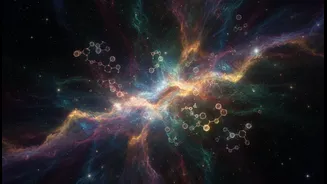
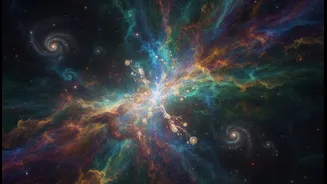
In a remarkable finding, astronomers have detected a rich and diverse collection of carbon-based molecules deep inside a galaxy known as IRAS 07251-0248. This galaxy is an ultra-luminous infrared galaxy, meaning it shines brightly in infrared light but
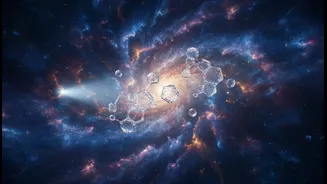
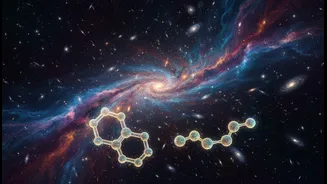
its core is hidden from view by thick clouds of dust and gas. Using the powerful infrared vision of the James Webb Space Telescope (JWST), scientists were able to peer through this cosmic dust and uncover a chemical environment far more complex than they ever predicted. Among the chemicals found were familiar names like methane, as well as more complex structures like benzene, a ring-shaped molecule. This suggests such galactic nuclei could act as vast 'factories' for organic molecules.
What 'Complex Organic' Really Means
The term 'organic' might make you think of life, but in chemistry, it simply means a molecule containing carbon atoms, often bonded with hydrogen and other elements. While simple organic molecules are common in space, the recent discoveries are notable for their complexity. Scientists have found molecules with multiple atoms, intricate ring structures, and even a highly reactive molecule called the methyl radical, seen for the first time outside our own Milky Way galaxy. These are not just simple compounds; they are the kinds of sophisticated structures that chemists see as crucial intermediate steps on the path toward prebiotic chemistry—the processes that may lead to life.
From Stardust to Life's Ingredients
This discovery is not about finding aliens. Instead, it's about understanding the universal availability of life's raw materials. For life as we know it to begin, you need a collection of key ingredients: amino acids, sugars, and the components of DNA and RNA. Discoveries like this, and others finding sugars and amino acid precursors in meteorites and star-forming regions, suggest that these crucial building blocks can form naturally in the harsh conditions of space. The findings from galaxy IRAS 07251-0248 add a major piece to this puzzle, showing that even the chaotic, high-energy environments near a supermassive black hole can be fertile ground for complex organic chemistry. The implication is that these materials could be widespread, ready to be delivered to young planets by comets and asteroids.
How the Webb Telescope Unlocked the Secret
Seeing into the heart of a dust-choked galaxy is impossible with conventional telescopes. The breakthrough came from the James Webb Space Telescope's advanced instruments, which are designed to capture infrared light. Different molecules absorb and emit light at specific infrared wavelengths, creating a unique chemical 'fingerprint'. This technique, known as spectroscopy, allowed researchers to analyze the light coming from the galaxy's core and identify precisely which molecules were present. By combining data from its NIRSpec and MIRI instruments, JWST provided an unprecedentedly clear view of the chemistry happening within a region that was previously hidden from sight.
A Universe More Friendly to Life?
Each discovery of complex organic molecules in a new cosmic setting reshapes our understanding of life's origins. It challenges the idea that Earth was uniquely special in its ability to generate prebiotic chemistry. Instead, it seems the universe is seeded with the necessary ingredients. From molecular clouds where stars are born to the disks of gas and dust where planets form, the chemical groundwork for life appears to begin long before planets even exist. While this doesn't guarantee that life is common, it significantly raises the probability that other rocky planets in the habitable zones of their stars received the same starter kit of ingredients that Earth did billions of years ago.