
A Celestial Masterpiece of Ice
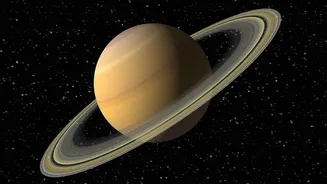
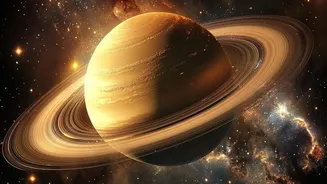
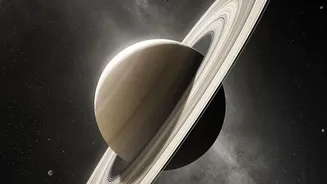
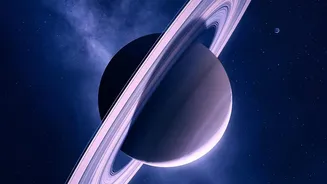
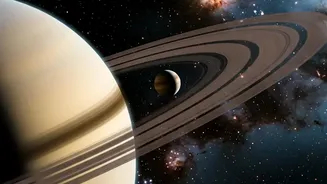
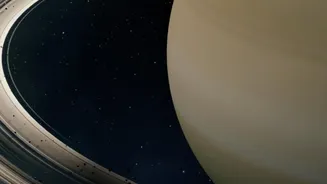
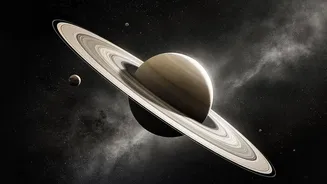
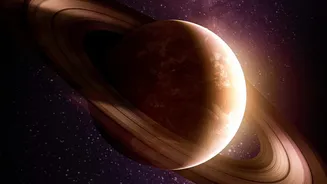
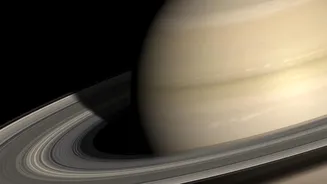
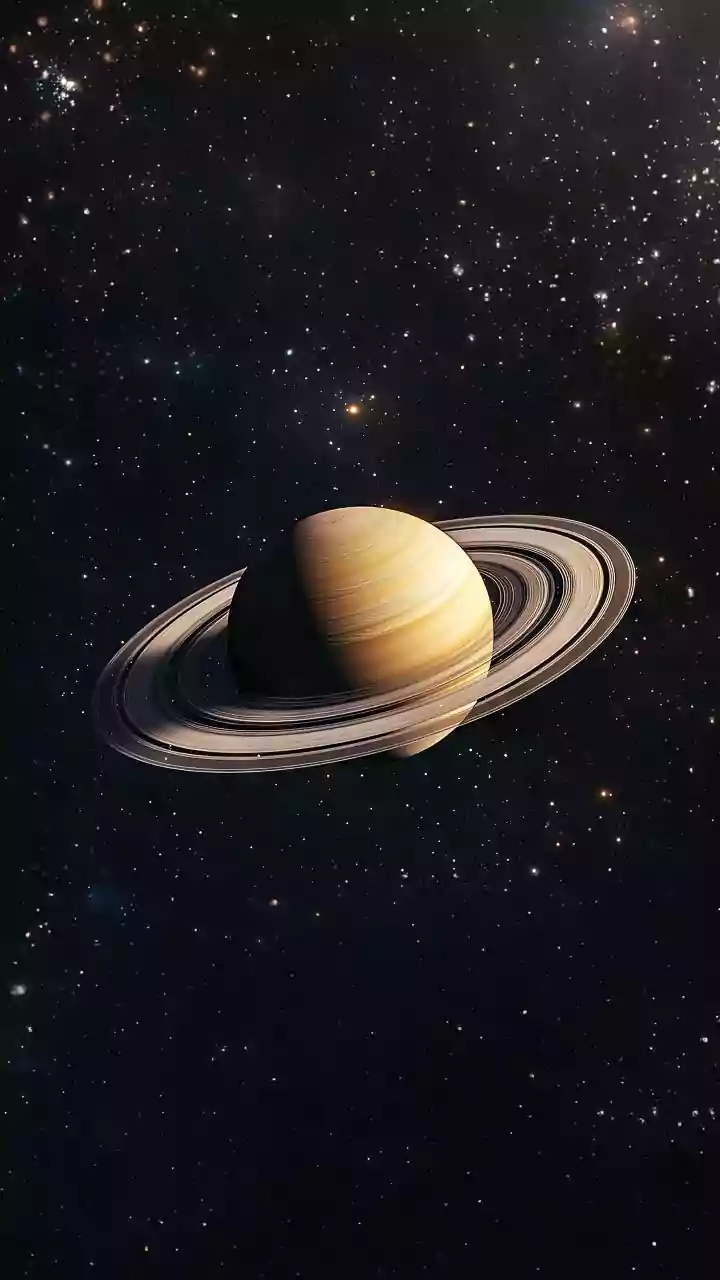
For centuries, we’ve marvelled at Saturn’s rings, a feature so vast it makes the planet an unmistakable jewel of the night sky. At first glance, they appear as solid, cohesive bands. In reality, they are an incredibly complex system composed of countless
individual particles of ice and rock, ranging in size from tiny dust grains to chunks as large as a house. Data from spacecraft like Cassini have revealed that these rings are astonishingly pure, made of about 99% water ice. This pristine nature is one of the biggest clues that their story is not as simple as once believed. If the rings were as old as Saturn itself, which formed 4.5 billion years ago, they should be much dirtier, darkened and contaminated by a constant bombardment of micrometeoroids over billions of years. Their cleanliness points to a much more recent, and dramatic, origin.
A Surprisingly Young Creation
The most startling revelation from recent decades of research is the age of the rings. For a long time, astronomers debated whether they formed alongside Saturn or were a later addition. Evidence gathered by NASA's Cassini mission, which studied the planet for 13 years, has tipped the scales dramatically. By measuring the mass of the rings and the rate at which space dust is polluting the ice, scientists have concluded the rings are likely only 100 to 400 million years old. To put that in perspective, when dinosaurs roamed the Earth, Saturn may have been a plain, ringless planet. This makes the rings a relatively new phenomenon in the solar system's long history, a temporary adornment rather than a permanent fixture.
The Violent Birth from a Lost Moon
So, if the rings are young, where did they come from? The leading theory is a story of cataclysmic destruction. One compelling hypothesis suggests that Saturn once had an additional icy moon. Researchers have nicknamed this doomed satellite 'Chrysalis'. About 160 million years ago, this moon’s orbit may have become unstable, possibly due to a gravitational tug-of-war with Saturn's largest moon, Titan. Chrysalis strayed too close to Saturn, crossing a critical boundary known as the Roche limit. Inside this zone, Saturn's immense gravity was stronger than the moon's own, and it tore Chrysalis apart. Computer simulations show that while the moon's rocky core would have plunged into the planet, its icy outer layers shattered and spread out into the brilliant, flat disc we see today. Another theory posits that a collision between two icy moons could have created the debris field that formed the rings.
The Disappearing Spectacle
Just as the rings had a violent birth, they are heading towards a quiet death. Scientists have discovered a phenomenon dubbed 'ring rain', where the icy particles from the rings are constantly being pulled into Saturn itself. Under the influence of the sun's ultraviolet light and Saturn's magnetic field, these ice particles become electrically charged and spiral down into the planet's upper atmosphere. The rate of this cosmic downpour is staggering. Estimates suggest an amount of water equivalent to an Olympic-sized swimming pool rains down from the rings every half hour. This constant loss of material means the rings are actively shrinking and will not last forever.
A Race Against Cosmic Time
The discovery of ring rain has allowed astronomers to put an expiration date on this celestial wonder. Based on the measured rate of material falling onto Saturn, the entire ring system is expected to be gone in a relatively short cosmic timeframe. The most cited estimates predict they will completely disappear within the next 100 million years, with some models suggesting it could be as long as 300 million years. While that sounds like an eternity in human terms, it's a fleeting moment compared to the solar system's 4.5-billion-year history. This means humanity has evolved at an incredibly fortunate time. We are living in a brief window where we can gaze up and witness the full glory of Saturn's rings, a transient spectacle that future inhabitants of Earth will never see.