







Meet the Veteran: Chandra
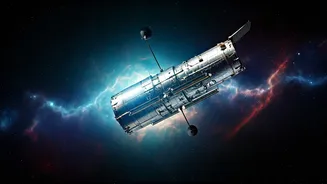
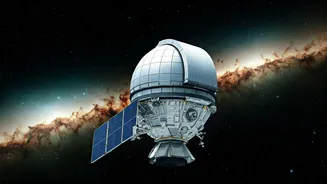
The hero of this story is the Chandra X-ray Observatory, one of NASA’s “Great Observatories.” Launched aboard the Space Shuttle Columbia on July 23, 1999, it has spent well over two decades revolutionizing our view of the cosmos. Named after Nobel Prize-winning
astrophysicist Subrahmanyan Chandrasekhar, Chandra was designed to detect X-ray emissions from the hottest and most energetic regions of the universe, like exploding stars, galaxy clusters, and the matter swirling around black holes. Because Earth’s atmosphere absorbs X-rays, this kind of astronomy is impossible from the ground. Chandra’s highly elliptical orbit takes it a third of the way to the Moon, allowing it to capture images of phenomena invisible to other telescopes. With a resolution eight times greater than any previous X-ray telescope, it has been a cornerstone of astrophysics for a generation.
A Legacy of Cosmic Discovery
For over two decades, Chandra has produced groundbreaking science, fundamentally changing our understanding of the universe. It has provided direct proof of dark matter, mapped the elements essential for life as they are blasted from supernovae, and given us our sharpest views of matter spiraling into supermassive black holes. Its data leads to roughly 400 scientific publications every year, making it one of the most productive missions in NASA history, on par with the Hubble Space Telescope. Just this year, Chandra continues to deliver, with observations identifying a potential new supernova remnant near our galaxy's center and studying the complex dynamics of stellar explosions. Its work often complements that of newer observatories like the James Webb Space Telescope, providing a crucial multi-wavelength view of cosmic events.
The Threat Is Not in Space, but on Earth
Unlike a dramatic space collision, the threat to Chandra is not technical failure or orbital decay—the spacecraft is healthy and has enough fuel to operate for perhaps another decade. The “rescue” it needs is from budget cuts on Earth. In early 2024, NASA's proposed budget for fiscal year 2025 included a drastic reduction in funding for Chandra, signaling a plan to effectively decommission the observatory. The proposal would have slashed funding from over $68 million annually to just over $41 million in 2025, and down to a mere $5.2 million by 2029, a level that would make science operations impossible. The plan shocked the global astronomy community, which saw it as shuttering a highly productive, fully functional observatory for what amounts to a rounding error in NASA’s overall budget.
A Grassroots Rescue Mission
The response from scientists and the public was swift and passionate. A movement under the banner #SaveChandra quickly organized, flooding social media and the halls of Congress with letters and petitions. Astronomers argued that shutting down Chandra would create a massive gap in astrophysics; there is no other telescope with its X-ray capabilities, and a potential successor mission is likely decades away. Losing the experienced staff and the continuous flow of unique data would be, in the words of some, an “extinction-level event” for X-ray astronomy in the United States. The comparison was made to having a beautiful, paid-for home and deciding to burn it down to avoid paying the utility bills for a year.
A Temporary Reprieve
The public and political pressure worked—to an extent. In late 2024, NASA announced that Chandra had been spared the chopping block, at least for another year. Funding was made available to avoid the immediate, catastrophic layoffs of the operations team and to continue much of its science through 2025. This move was a dramatic reversal from the initial plan and a testament to the community's advocacy. However, the reprieve is temporary. The long-term future of Chandra remains in limbo, subject to the outcomes of future budget negotiations and a senior review in 2025. While the veteran observatory has been pulled back from the brink, the fight to secure its future and its invaluable scientific legacy continues.