



A Race Against Time
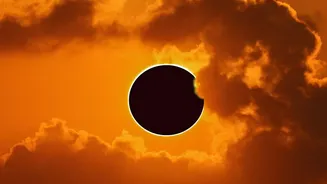
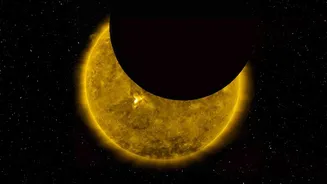
While millions looked up in wonder as the total solar eclipse carved its path across Greenland, Iceland, and Spain, teams of scientists were engaged in a frantic race against time. A total solar eclipse offers a fleeting, precious window to study the corona,
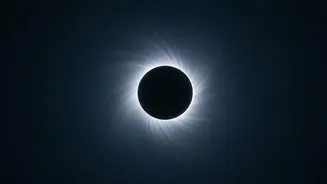
which is normally drowned out by the Sun’s brilliant surface. This faint halo of plasma, or ionised gas, is a scientific enigma, and the few minutes of totality are the best chance we get from Earth to gather crucial data. To maximise this brief opportunity, some researchers took to the skies. NASA flew its WB-57 high-altitude research aircraft along the eclipse path, extending its observation time to nearly three minutes as it chased the Moon's shadow at over 740 kilometres per hour. These missions aimed to capture high-resolution images and data to help unravel the secrets hidden within the corona's ghostly tendrils.
The Coronal Heating Paradox
The central mystery that drives this intense research is a baffling paradox: the corona is hundreds of times hotter than the Sun's surface. While the visible surface, or photosphere, simmers at about 5,500 degrees Celsius, the corona reaches a staggering one to two million degrees, and sometimes even hotter in active regions. This defies simple logic. It’s like a fire being cooler than the air several feet away from it. For decades, astrophysicists have debated how the corona gets super-heated. The leading theories involve energy being transported and released into the extremely tenuous atmosphere. One idea points to a constant storm of tiny explosions called 'nanoflares', caused by the snapping and reconnecting of tangled magnetic field lines. Another theory involves different types of plasma waves carrying energy up from the surface, essentially 'shaking' the corona and heating it.
A Coordinated Effort on Earth and in Space
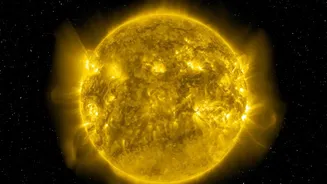
The August 12 eclipse was not just observed from the ground and high-altitude jets. It was a coordinated effort involving some of our most advanced space missions. The European Space Agency's Solar Orbiter and Proba-3 missions, along with NASA's Parker Solar Probe, were all positioned to contribute. Proba-3 is particularly innovative, consisting of two spacecraft flying in precise formation to create an artificial, long-lasting eclipse that can last for hours, offering a much longer view of the inner corona than a natural eclipse allows. Meanwhile, Solar Orbiter provided a different viewpoint, capturing data of the Sun's magnetic field that is crucial for building accurate predictive models. Indian scientists from the Raman Research Institute also contributed, using data to predict the complex 'petal-like' magnetic structures they expected to see in the corona during the event.
What Did We Hope to Learn?
The key goals of the research during the 2026 eclipse were multifaceted. A primary aim was to better understand the mechanisms behind coronal heating. By capturing images in different wavelengths of light, scientists hope to distinguish between the heating effects of nanoflares and plasma waves. Another major objective was studying the origin of the solar wind, the constant stream of charged particles that flows from the Sun and travels through our solar system. These particles can impact Earth by disrupting satellites, communication networks, and even power grids. Early results from missions like Proba-3 have already shown that parts of the solar wind move much faster near the Sun than previously predicted. The eclipse observations will help connect the structures seen in the corona directly to the solar wind that flows past our spacecraft, providing a more complete picture of this critical process.
The Long Road of Analysis
While the eclipse itself lasted only minutes, the scientific discovery process has just begun. The terabytes of data captured by aircraft, balloons, ground-based telescopes, and spacecraft will be meticulously analysed for months and years to come. Scientists will compare the actual images of the corona with the predictions made by computer models to refine their understanding of the Sun's magnetic field. Each eclipse adds a new piece to the puzzle. The data from August 12 will be compared with observations from past eclipses, like the one in 2024, to see how the corona changes as the Sun moves through its cycle of activity. By piecing together these fleeting glimpses, we move closer to solving the Sun’s most enduring mysteries and better predicting how our star's activity will affect our technological world.