



Earth: The Ultimate Blueprint for Life
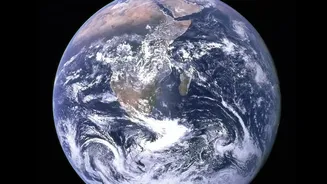
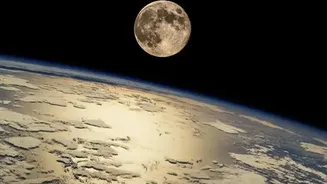
When astronomers scan the skies for planets that could host life, they aren't just looking for any celestial body. They are looking for a world that shares characteristics with the only known inhabited planet in the universe: Earth. Our world provides
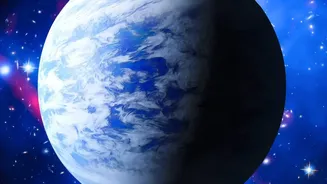
the essential template for what a life-bearing planet looks like. Two features are paramount: the presence of liquid water and a specific type of atmosphere. Earth's oceans and its gaseous envelope work together to create stable, life-supporting conditions. This makes our planet the primary model for identifying exoplanets — planets outside our solar system — that might have the right conditions for life to emerge and thrive.
Hunting for Atmospheric 'Biosignatures'
An atmosphere is crucial because it can hold clues about what's happening on a planet's surface. Scientists search for what they call "biosignatures" — substances, elements, or phenomena that provide evidence of past or present life. On Earth, life has fundamentally altered our atmosphere, filling it with gases like oxygen. Without photosynthetic life, our atmosphere would have virtually no oxygen. Therefore, detecting oxygen, along with other gases like methane, in the atmosphere of a distant, rocky exoplanet could be a powerful indicator of biological activity. These gases are considered strong biosignatures because their simultaneous presence is hard to explain through purely geological or chemical processes.
How to 'Read' an Alien Atmosphere
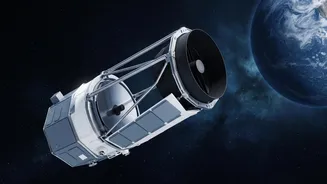
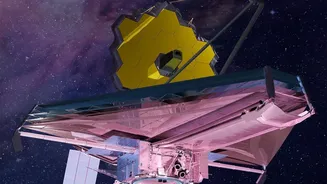
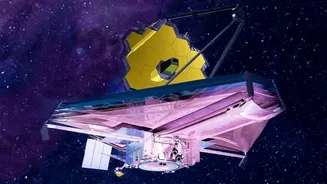
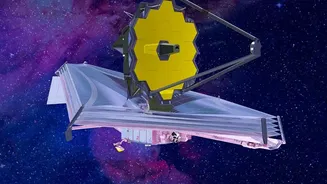
Astronomers can't visit these distant worlds, so they use clever techniques to study them from light-years away. The primary method is called transit spectroscopy. When an exoplanet passes in front of its host star from our point of view, a tiny fraction of the starlight filters through the planet's atmosphere. Different gases in that atmosphere absorb light at specific, characteristic wavelengths. By capturing this light with powerful observatories like the James Webb Space Telescope (JWST), scientists can break it down into a spectrum, revealing which wavelengths are missing. These missing pieces act like a chemical fingerprint, telling astronomers what elements and molecules, such as water vapor, methane, or carbon dioxide, are present in the exoplanet's air.
The Indispensable Role of Water
Life as we know it requires liquid water. For this reason, the search for habitable exoplanets often begins by identifying worlds orbiting within their star's "habitable zone." This is the region where temperatures are just right—not too hot and not too cold—for liquid water to exist on the planet's surface. An atmosphere plays a critical role here as well; it provides the necessary pressure to stop water from boiling away into space and can trap heat through the greenhouse effect, keeping the surface warm enough for oceans, rivers, and lakes. Detecting water vapor in an exoplanet's atmosphere is a major step, as it serves as a proxy for the potential presence of liquid water on the surface.
Beyond the Earth Template
While Earth is an excellent starting point, scientists are aware of the limitations of a purely Earth-centric view. Life elsewhere could be fundamentally different, not relying on water or producing the same atmospheric gases. This has led to the concept of "agnostic biosignatures," which are signs of life not tied to any specific Earth-based biology. These might include unexpected levels of chemical complexity or gases that are out of balance in a way that suggests some active process—life—is regulating them. By keeping an open mind, researchers hope to be able to recognize life even if it looks nothing like what we're used to, expanding the search beyond mere Earth-like worlds to any planet showing the undeniable fingerprints of biology.