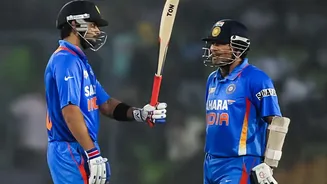






It is the definitive debate for a generation of Indian cricket fans. Sachin Tendulkar or Virat Kohli? While their batting records are endlessly compared, the eternal question remains: who faced the genuinely tougher bowlers? This isn't just a list of names;
it's a tale of two distinct eras in cricket.
Tendulkar and the Age of Legends
Sachin Tendulkar’s career, stretching from 1989 to 2013, overlapped with what many consider a golden era of bowling. He debuted against the fierce Pakistani duo of Wasim Akram and Waqar Younis, masters of conventional and reverse swing. Soon after, he was contending with the West Indies' final generation of pace legends, including Curtly Ambrose and Courtney Walsh, known for their relentless accuracy and steepling bounce. Then came the Australians. Glenn McGrath’s metronomic, suffocating line and length became one of Tendulkar's greatest rivalries. Adding to the challenge was Shane Warne, arguably the greatest leg-spinner of all time, and Sri Lanka's Muttiah Muralitharan, the highest wicket-taker in history. This era was defined by variety and skill. Bowlers like South Africa's Allan Donald possessed raw pace, while Shaun Pollock was a master of seam movement. The single white ball in ODIs scuffed up, making reverse swing a potent weapon in the latter stages of an innings, a skill Akram and Younis perfected. The sheer diversity of world-class threats, from extreme pace to mystifying spin, was immense.
Kohli and the Modern Athlete-Bowler
Virat Kohli, who debuted in 2008, walked into a different cricketing world. The bowlers he faced were products of a new age of professionalism, fitness, and data analytics. While the concentration of all-time greats might seem less dense, the overall standard of pace bowling was arguably higher and more physically demanding. Kohli has battled James Anderson, Test cricket's most successful pacer, especially in swinging English conditions—a challenge Kohli himself has acknowledged. He has also competed against Dale Steyn at his peak, a bowler with express pace and the ability to swing the ball both ways. The current generation of fast bowlers, including Pat Cummins, Mitchell Starc, and Kagiso Rabada, are phenomenal athletes who can maintain high speeds for longer spells. In limited-overs cricket, the rise of T20 has produced a new breed of 'mystery' spinners like Sunil Narine and Adil Rashid, bowlers who have frequently troubled Kohli with their variations. The modern bowler is often armed with extensive video analysis, plotting a batsman's weaknesses with scientific precision.
Rules, Pitches, and the Shifting Balance
A simple comparison of names doesn't tell the whole story. The playing conditions and rules have evolved significantly. For much of Tendulkar's ODI career, only two fielders were allowed outside the 30-yard circle for the first 15 overs, but fielding restrictions were less complex later in the innings. In contrast, Kohli’s era saw the introduction of two new white balls in ODIs. This rule change, which was in place for a significant part of his peak, largely negated reverse swing, making death-over hitting more predictable for batsmen. It has been argued that pitches, particularly in white-ball cricket, have become more batter-friendly to satisfy the demand for high-scoring games. Furthermore, bat technology has advanced, with modern bats offering a larger sweet spot and more power than the equipment used in the 1990s and early 2000s. The introduction of the Decision Review System (DRS) also gives batsmen a lifeline that Tendulkar did not have for the majority of his career.
The Verdict: A Subjective Conclusion
So, who had it tougher? The argument for Tendulkar rests on the sheer pedigree and iconic status of the bowlers he faced. The 1990s are often seen as a bowling-dominant era where batters had to contend with a wider array of unique and potent skills without the aid of modern technology or fielding restrictions. Facing Wasim Akram's reverse swing, Shane Warne's leg-spin, and Glenn McGrath's accuracy in the same decade presents a formidable case. The argument for Kohli is that he has faced a generation of bowlers who are fitter, faster for longer, and more prepared thanks to modern analytics. While there may be fewer bowlers from his era who will achieve the legendary status of a Warne or Muralitharan, the average international bowler is a more polished and professional athlete. Ultimately, the question may be unanswerable. Tendulkar faced a higher concentration of all-time greats in an era arguably favouring bowlers. Kohli has thrived against uniformly professional and athletic attacks in an era that often gives the batsman the edge. Both scenarios present a unique and immense challenge, solidifying the status of both men as masters of their craft.