







The solution to Earth's immense and growing data-processing needs might be found in the sky. But as companies race to build data centers in orbit, a significant concern is growing: the potential to permanently brighten our night sky.
What Are Orbital Data Centres?
Imagine a network
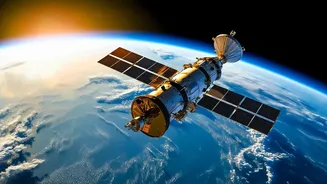
of satellites that don't just transmit data, but actively process and store it. This is the core concept of space-based data centers. Companies like SpaceX, Starcloud, Axiom Space, and others are developing plans to place powerful computing infrastructure into low Earth orbit. These are not just storage lockers in the sky; they are envisioned as fully operational centers for everything from AI model training to secure data housing, functioning as an 'orbital cloud'. The idea has moved from science fiction to a serious business proposition, with test satellites already being launched and major players like Google and NVIDIA developing specialized hardware for the harsh environment of space. Proponents argue this is the next logical step in our data-driven world, an evolution from terrestrial facilities to a new frontier.
The Business Case for Going to Space
The push to move data centers off-planet is driven by powerful terrestrial constraints. On Earth, data centers consume enormous amounts of energy and water for cooling, with a single AI-focused facility sometimes requiring the power of a small city. Global data center energy demand is projected to exceed 1,000 terawatt-hours in 2026, roughly equivalent to the entire consumption of Japan. Space offers a compelling alternative: constant, unfiltered solar power and the vacuum of space as a 'free' cooling mechanism via radiation. Companies see this as a way to bypass congested power grids and environmental regulations on the ground. Furthermore, orbital data centers offer unparalleled security, physically isolated from terrestrial threats like natural disasters or geopolitical instability, making them attractive for high-security and data sovereignty use cases.
A New Threat to the Night Sky
While the benefits sound promising, the astronomical community and environmental groups are raising alarms about a significant, and potentially irreversible, side effect: light pollution. These orbital data centers, particularly those designed for heavy-duty AI processing, would require massive solar arrays to generate power—some potentially kilometres in size. If placed in sun-synchronous orbits to maintain constant sunlight, these large, reflective structures would be visible for extended periods around sunset and sunrise. One study estimated that a large data center satellite could be 100 times brighter than the brightest stars, shining with an intensity several times that of Venus. A sky filled with thousands, or even a million such objects as some proposals suggest, would fundamentally alter our view of the cosmos.
Astronomers Raise Concerns
For astronomers, the threat is existential. Ground-based observatories are already struggling with the bright streaks left by existing satellite mega constellations like Starlink, which can contaminate images and render expensive research data useless. The sheer number and predicted brightness of data center satellites would be far worse. The Royal Astronomical Society (RAS) warns that these constellations could obscure a significant percentage of data from key instruments like the Very Large Telescope. The problem isn't just visible streaks; the cumulative light from these satellites can increase the overall brightness of the sky, or 'skyglow,' making it impossible to detect faint, distant objects. This threatens to blind our most powerful tools for understanding the universe and effectively end groundnded astronomy as we know it.
Beyond Astronomy: Broader Environmental Impacts
The concerns extend beyond the scientific community. A coalition of environmental groups has petitioned for a full environmental review of these projects, citing numerous risks. Increased light pollution is known to disrupt wildlife, affecting the migration patterns of birds and the predator–prey balance of nocturnal animals. There is also the issue of atmospheric pollution. Rocket launches produce emissions like black soot, which have a much more potent warming effect high in the atmosphere. Furthermore, when these satellites eventually deorbit, they burn up, releasing aluminum oxides and other metals into the upper atmosphere, with unknown long–term consequences for the ozone layer and climate. Finally, adding hundreds of thousands of new objects to orbit dramatically increases the risk of collisions and the creation of more space debris, a problem that is already a major concern.