



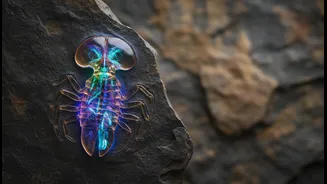


Meet the Ancient 'Sea Lilies'
Long before dinosaurs roamed the Earth, in fact, more than 200 million years before the first ones appeared, the planet’s oceans teemed with strange and beautiful life. Among the most common residents were crinoids, creatures that looked so much like
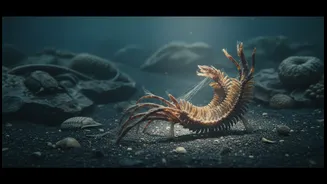
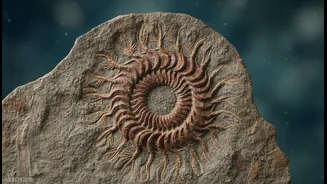
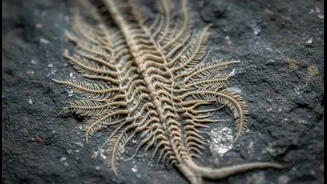
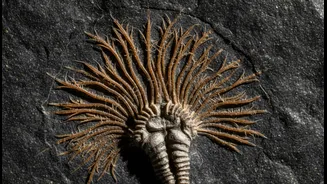
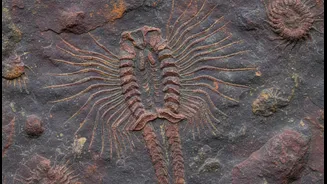
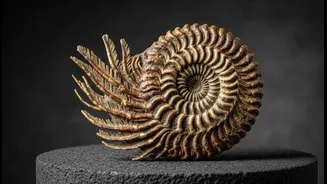
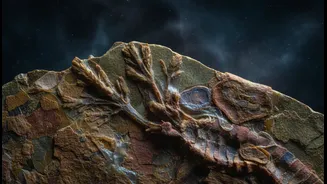
underwater flowers that they earned the nickname 'sea lilies'. But these were no plants. Crinoids are animals, ancient relatives of today's starfish and sea urchins. They typically consist of a 'stem' that anchors them to the seafloor, a cup-like body called a calyx, and a crown of feathery arms that they used to filter food particles from the water. For millions of years, their fossilized remains have been found all over the world, but these fossils almost always tell an incomplete story, preserving only the hard, skeletal plates of the animal. The delicate soft tissues—the parts that actually made the animal live and breathe—were thought to be lost to time.
The Rarity of a Perfect Fossil
Fossilization is a brutal process that heavily favors hard materials. After an animal dies, its soft tissues like skin, organs, and muscles are the first things to decay or be eaten. For them to be preserved, a 'one in a million' set of circumstances is required. The animal must be buried rapidly in sediment, in an environment with very low oxygen to halt the process of decay almost immediately. It’s like nature creating a perfect vacuum seal. Because these conditions are so exceptionally rare, paleontologists have had to reconstruct the lives of ancient creatures based primarily on their skeletons, making educated guesses about their internal anatomy and behavior based on living relatives. This has always left a massive gap in our understanding, a ghost of an animal we can see but not fully know.
A Discovery Hiding in Plain Sight
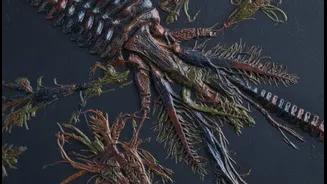
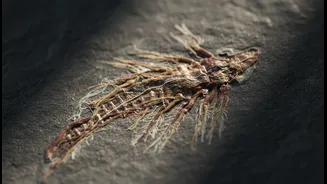
The latest breakthrough didn't come from a dusty cliffside, but from a museum drawer. Researchers from the University of Oklahoma were examining a specimen of a crinoid known as Dendrocrinus simcoensis at a small museum in Montréal when they noticed something extraordinary. This particular fossil, dating back 450 million years to the Ordovician period, held a secret that had been overlooked. Preserved in stunning detail were the creature’s 'tube feet'—delicate structures used for feeding. This is only the second time in history that soft tissue has ever been found in a crinoid fossil, and this specimen is by far the oldest. The discovery was a paleontological lightning strike, offering a direct look at the biology of an animal that lived in Earth's earliest complex reef ecosystems.
Rewriting the Rules of Ancient Life
So, why does the preservation of tiny tube feet matter so much? Because their structure tells us how the animal actually lived and fed. According to the research team, the arrangement of these ancient tube feet is significantly different from those of modern crinoids. This suggests that these early crinoids had feeding strategies and occupied ecological niches that have no direct equivalent in today's oceans. Instead of just having a skeleton, we now have a glimpse into the animal's behavior. It is the equivalent of trying to understand a car engine by only looking at its chassis, and then suddenly being handed the original technical manual. This single fossil provides a concrete data point that replaces decades of speculation, forcing scientists to redraw their understanding of how these ancient animals interacted with their environment. It challenges the assumption that ancient versions of animals were simply primitive copies of what we see today.
A New Window into a Lost World
The discovery does more than just update textbooks on crinoids; it highlights a fundamental shift in how science reconstructs the past. It proves that there are still revolutionary discoveries waiting to be made, not just in the field but in the carefully curated collections of museums, large and small. Each fossil that preserves a hint of soft tissue is a Rosetta Stone for its time, allowing us to translate the hard evidence of skeletons into the vibrant reality of living, breathing organisms. This find provides a clearer picture of how life evolved in the oceans hundreds of millions of years ago, demonstrating that the 'tree of life' had branches and experiments that were previously unimaginable. It’s a powerful reminder that the story of life on Earth is far from complete, with incredible chapters still waiting to be read.