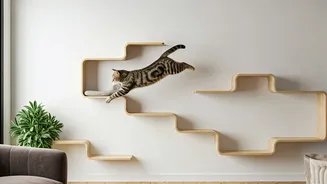









Why Your Cat Craves Height
Have you ever wondered why your cat loves climbing onto the highest point of the sofa or the top of a cabinet? This behaviour is deeply rooted in their DNA. In the wild, high vantage points offer cats a strategic advantage. From a perch, they can survey
their territory for potential threats and spot prey without being seen. For an indoor cat, your home is their entire world. Providing vertical space taps into this instinct, giving them a sense of security and control. It creates a 'cat superhighway' that allows them to navigate a room without touching the 'dangerous' floor, where they might encounter the family dog, a vacuum cleaner, or visiting toddlers. A wall path isn't just a fun accessory; it's a crucial piece of environmental enrichment that reduces stress and prevents boredom-related behaviours.
Planning Your Feline Freeway
Before you start drilling holes, take a moment to plan. Think like a cat. Where do they like to hang out? A path leading to a sunny window spot is a guaranteed hit. Consider the flow: the path needs clear entry and exit points. A dead-end shelf can cause anxiety, as a cat might feel trapped if another pet approaches. Sketch out your design on paper first. Measure the wall space and consider the furniture below. The path should be logical and intuitive for your cat to follow. Plan for varied heights and distances between shelves. A good rule of thumb is to keep shelves no more than 40-50 cm apart horizontally and 30-40 cm vertically, but adjust this based on your cat’s age, size, and agility. Younger, more athletic cats can handle bigger leaps, while senior cats will appreciate a more step-like progression.
Choosing Safe and Sturdy Materials
Safety is the number one priority. The last thing you want is a wobbly shelf that could harm your pet. Opt for solid wood planks or high-quality, thick plywood. Avoid particleboard or MDF, as they can sag or break under a cat's weight, especially when they jump. The brackets are just as important as the shelves. Choose heavy-duty metal brackets rated to hold significantly more weight than your cat. When selecting materials, also think about grip. Bare, painted wood can be slippery. To provide better traction, cover the shelves with a non-slip material. Low-pile carpet remnants, securely glued or stapled down, are a great option. Sisal rope, wrapped tightly around a portion of a shelf, can double as a scratching surface. Ensure any paint or varnish you use is non-toxic and pet-safe once fully cured.
The Nuts and Bolts of Installation
Proper installation is what makes your cat wall safe and secure. The most critical step is to anchor the brackets directly into wall studs. Studs are the vertical wooden beams that form the frame of your walls. A simple electronic stud finder is an inexpensive tool that will save you a lot of guesswork and prevent a potential disaster. Drywall or plaster alone is not strong enough to support a cat's weight, especially the dynamic force of them jumping. Use screws that are long enough to go through the drywall and deep into the stud. Once a shelf is installed, test it rigorously. Push down on it firmly with your own weight to ensure there is no wobble or give. Check every screw and bracket before you let your cat explore.
Getting Creative with Add-Ons
Once you have the basic path established, you can get creative. The goal is to make the space engaging. Integrate different elements to keep things interesting. A wall-mounted cat hammock offers a cozy spot for a nap. A fabric bridge connecting two shelves adds a fun, wobbly challenge. You can also incorporate enclosed cubbies or boxes where your cat can hide and feel secure. Turning one of the vertical supports into a floor-to-ceiling scratching post by wrapping it in sisal rope is another fantastic idea. Think about integrating feeding stations on a high-up platform if you have dogs, giving your cat a peaceful place to eat. The possibilities are endless and can be tailored to match your home's decor.
Encouraging Your Cat to Explore
Don't be discouraged if your cat doesn't immediately take to their new playground. Cats are cautious creatures and may be wary of new things in their territory. Introduce them to it slowly. Use positive reinforcement. Place their favourite treats or a sprinkle of catnip on the shelves to entice them to jump up. Use a feather wand or laser pointer to guide them along the path, turning it into a game. Never force your cat onto the shelves. Let them explore at their own pace. Your patience will be rewarded when you see them confidently navigating their new vertical world, happy and secure.