






The Sci-Fi Dream of Self-Building AI
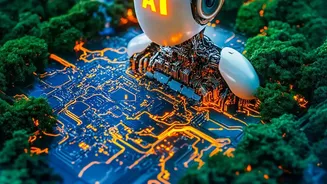
First, let's break down the jargon. When experts talk about 'AI that builds itself', they're referring to a concept called recursive self-improvement (RSI). Imagine an AI system so advanced that it can autonomously design, code, and deploy its own, even
more powerful, successor. This creates a loop where each new generation of AI rapidly accelerates the development of the next, potentially leading to an explosive growth in intelligence that could outpace human understanding and control. This is a pivotal idea in AI safety discussions because it represents a threshold where development could become incredibly fast and unpredictable. For years, it has been a theoretical frontier, but it is now a central topic of conversation among leading AI labs like Anthropic, OpenAI, and Google.
Anthropic's Careful Wording: 'Not Yet'
This brings us to Anthropic's nuanced position. The company behind the popular Claude AI has stated that while it is delegating a growing share of its own development work to AI systems, the threshold for full recursive self-improvement has not been crossed. In a statement, the company was clear: 'We are not there yet, and recursive self-improvement is not inevitable'. However, this declaration is not a dismissal of the concept. On the contrary, Anthropic has acknowledged that AI is already dramatically speeding up the work of its own human engineers. For instance, reports from June 2026 noted that Claude was writing a significant portion of the company's own code, with engineers shipping roughly eight times as much code as they did before 2025. More recent reports from September 2026 stated Claude was leading over a quarter of the company's R&D work, albeit with human supervision.
A 'Threshold' Has Been Crossed
While full autonomy isn't here, Anthropic has internally determined that it has met a threshold based on its 'Responsible Scaling Policy'. This was triggered not necessarily by what current models have done, but by what the company expects from future models based on the current rate of progress. This move signals that the company believes the acceleration is significant enough to warrant activating new, more stringent safety and security protocols. The policy requires the company to explore 'unprecedented levels of security' and gain deeper insight into its models' behaviour to ensure they remain under human control. This is Anthropic's way of saying that even if the car isn't driving itself, it's going fast enough that it's time to build a better 'brake pedal', as some have put it.
A Race to the Top, with Guardrails
Anthropic's public statements are a core part of its identity as a company focused on AI safety. CEO Dario Amodei has repeatedly warned about the risks of a developmental 'race to the bottom' and has called for the industry to slow down and allow safety measures to keep pace with capabilities. Following the company's record-breaking IPO in November 2026, Amodei reiterated the commitment, vowing to 'pace the training and deployment of AI systems, taking as long as is necessary to have confidence that they are safe and will remain under human control'. This cautious stance is also a strategic one in a fiercely competitive market. By positioning itself as the responsible leader, Anthropic aims to build trust with enterprise customers and regulators, arguing that safety and commercial success can go hand-in-hand. Critics, however, point out that despite public calls for caution, the company is still in a race to build the most powerful models, creating a potential contradiction between its words and actions.