


ISRO's Innovative Eye on Our Planet
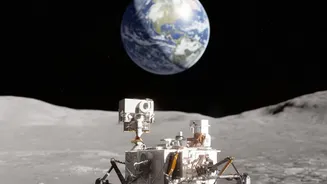
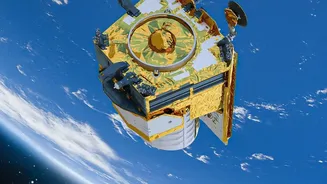
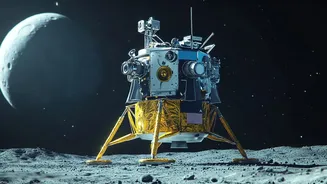
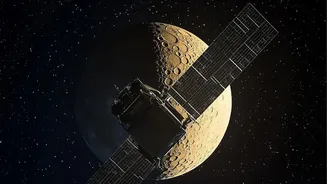
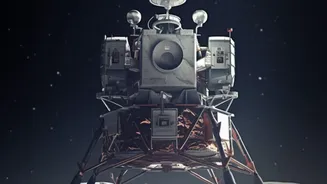
Tucked away on the Chandrayaan-3 mission's Propulsion Module—the component responsible for carrying the lander and rover to the Moon—was a single, ingenious scientific payload. It wasn't designed to study the Moon, but to turn its gaze back towards our
own world. This instrument is called SHAPE, which stands for Spectro-polarimetry of a Habitable Planet Earth. Developed by scientists at the U. R. Rao Satellite Centre in Bengaluru, SHAPE's purpose was to do something remarkably clever: observe Earth from the unique vantage point of lunar orbit and analyze its light as if it were a distant, unknown exoplanet. By studying the one planet we know for certain harbours life, ISRO aims to create a definitive benchmark—a 'how-to' guide for identifying other potentially habitable worlds scattered across the galaxy.
Decoding Earth's Light for Clues to Life
The science behind SHAPE is called spectro-polarimetry. It sounds complex, but the idea is straightforward. When sunlight bounces off a planet, the reflected light carries subtle clues about what it hit. Spectroscopy breaks this light down into its constituent colours, revealing the chemical composition of the planet's atmosphere—gases like oxygen, carbon dioxide, and water vapour. Polarimetry adds another layer of information by measuring the orientation of the light waves. This can tell scientists about clouds, oceans, and even continents on the planet's surface. By combining these two techniques, SHAPE collected detailed signatures of Earth's light in the near-infrared spectrum. The goal was to see if the known features of our living world—its vast oceans, swirling clouds, and continents teeming with vegetation—produce a unique, identifiable spectro-polarimetric fingerprint that could be spotted from light-years away.
Our Planet, The Ultimate Test Subject
To find a potentially habitable exoplanet, astronomers need to know exactly what they're looking for. This is where SHAPE's experiment becomes crucial. By observing Earth from its stable lunar orbit, the instrument was able to capture the 'disc-integrated' light of our planet—meaning, all the light from the entire Earth disc, averaged out into a single point, just as we would see a distant exoplanet through a powerful telescope. Over its operational period, SHAPE observed how this light signature changed as Earth rotated, revealing different faces like oceans and landmasses, and as it moved through different phases. This data provides a comprehensive baseline. It validates that the signatures of habitability we theorise about are, in fact, detectable. Essentially, ISRO used our home planet as a perfect laboratory subject to calibrate the very methods that will be used in future exoplanet-hunting missions.
A Blueprint for Future Discoveries
The data gathered by SHAPE is not about learning something new about Earth, but about creating a vital reference catalogue for astronomers globally. When future advanced telescopes, like the successors to the James Webb Space Telescope, turn their mirrors toward rocky exoplanets in the habitable zones of distant stars, they will be looking for light signatures that match the patterns SHAPE has meticulously recorded. A planet showing similar variations in polarised light could indicate the presence of clouds and oceans, while specific spectral dips might suggest an oxygen-rich atmosphere—a potential biosignature. In an unexpected but brilliant extension of its mission, ISRO used leftover fuel to manoeuvre the Propulsion Module out of lunar orbit and back into a high Earth orbit, allowing SHAPE to continue its observations and providing valuable experience for future sample-return missions. This experiment has firmly established India as a key contributor to one of the grandest scientific quests of our time: the search for another Earth.