






The Glow That Hides the Cosmos
The biggest challenge for any aspiring urban astronomer is light pollution. This is the excessive, misdirected, or obtrusive artificial light that floods the night sky, creating a dome of brightness over cities. This glow dramatically reduces the visibility
of stars, planets, and distant galaxies. While a rural sky might reveal thousands of stars, a city sky can reduce that number to just a few dozen. This makes identifying constellations and spotting planets a frustrating, often impossible, task for the unaided eye. It’s not that the stars have disappeared; they are simply outshone. This is the fundamental problem that modern smartphone astronomy tools are designed to overcome, not by changing the sky, but by changing how we see it.
Your Pocket-Sized Celestial Compass
The magic of a stargazing app begins with the sophisticated sensors packed inside your smartphone. These apps don't need a Wi-Fi or data signal to function once their star catalogue is downloaded. Instead, they rely on a trio of internal instruments to know exactly where and how you are looking. First, the GPS determines your precise location on Earth. Second, a magnetometer (your phone's internal compass) figures out which direction you are facing. Finally, an accelerometer and gyroscope work together to measure the phone's tilt and orientation. By combining this data—your location, the direction you’re pointing, and the angle of your phone—the app can calculate precisely which slice of the sky should be in your view at that exact moment.
A Universe of Data
Knowing where you're looking is only half the battle. The app also needs to know what is actually in the sky. To do this, they contain vast databases of celestial objects. These digital star charts are the modern equivalent of ancient astronomical almanacs, cataloging hundreds of thousands of stars, planets, constellations, nebulae, and galaxies. Apps like SkyView and Star Walk can identify over 200,000 celestial objects. These catalogues are not just lists of names; they contain the precise coordinates and orbital data for planets, moons, asteroids, and even man-made satellites like the International Space Station. By cross-referencing your viewing position with this immense dataset, the app can generate an accurate map of the sky above you in real-time.
Augmented Reality Brings It to Life
This is where the experience becomes truly immersive. Most popular stargazing apps use augmented reality (AR) to overlay their star map directly onto your real-world view. When you grant the app camera access, it shows you the scene through your phone's lens but enhances it with a digital layer of information. As you point your phone at a dim star, the app displays its name, draws the lines of its constellation, and might even show artistic renderings of the mythological figures they represent. This AR feature doesn't require you to see the object clearly with your naked eye. The app already knows a planet or star is supposed to be there based on its calculations. The AR overlay simply points you to the exact spot, labeling what is often invisible.
Seeing Through the Noise
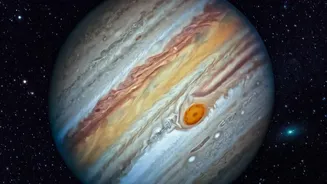
So, how do these tools specifically cut through light pollution? The truth is, they don't magically make your eyes see more stars. Instead, they bypass the limitations of human vision by relying on pure data. The app knows from its calculations that Jupiter is in a specific spot, even if the city glow makes it indistinguishable from the hazy background to you. By showing you an augmented reality map, it points to that exact location and tells you what you should be seeing. It's less about seeing through the light pollution and more about having a perfect, unerring guide that is unaffected by it. Some apps also allow you to adjust the light pollution settings to better simulate what you can realistically expect to see, while others are developing astrophotography features that use the phone's camera for long-exposure shots, which can capture more light than the human eye and reveal fainter objects.