




The Allure of a Metal World
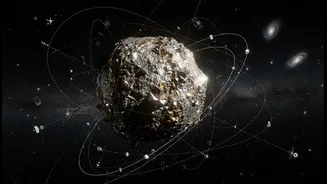
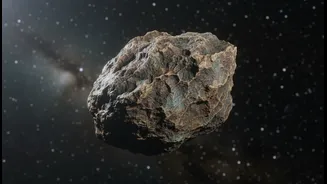
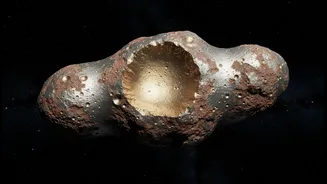
Located in the main asteroid belt between Mars and Jupiter, 16 Psyche is one of the most massive objects there, measuring about 222 kilometers in diameter. For a long time, scientists theorized that it was the leftover iron-nickel core of a planetesimal,
a building block of a planet that was destroyed in violent collisions billions of years ago. This made Psyche a unique and invaluable target; studying it would be like getting a direct look at the core of a planet like Earth, which is otherwise inaccessible beneath thousands of kilometers of rock. Early observations supported this idea, as the light reflecting from its surface resembled that of metallic objects. The prospect of visiting a world made of metal, not rock or ice, was so compelling that NASA designed and launched a dedicated mission to explore it.
Puzzling Contradictions Emerge
Even before the latest data, there were hints that the story of Psyche wasn't so simple. Measurements of the asteroid's density produced a puzzling contradiction. If Psyche were a solid chunk of iron-nickel, its density should be around 7,900 kilograms per cubic meter. However, calculations based on its gravitational pull on other asteroids placed its density at roughly half that value, somewhere between 3,400 and 4,100 kg/m³. To account for this, scientists would have to assume the asteroid had an incredibly high porosity of 50%, essentially meaning it was half empty space. For an object so large, this seemed highly unlikely, suggesting something was amiss with the pure-metal-core theory.
New Data Paints a Heterogeneous Surface
Recent, more detailed observations have provided a clearer picture, effectively ruling out the old, simple model. Using the combined power of ground-based radio telescopes like the Atacama Large Millimeter/submillimeter Array (ALMA), scientists have created high-resolution maps of Psyche's thermal emissions. These maps show that the surface is surprisingly varied, or heterogeneous. Instead of a uniform metallic surface, the data indicates a mixture of materials. While the surface is indeed rich in metals, the abundance varies significantly from place to place, with large regions of silicate rock also present. The latest analysis suggests metal comprises between 30% and 60% of Psyche's volume, a significant departure from the previous 90-95% estimates.
From Solid Core to a Mixed World
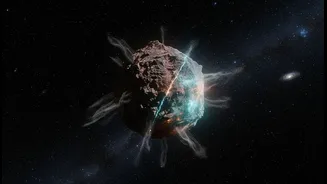
This new evidence fundamentally changes our understanding of Psyche. It is no longer considered a solid, exposed planetary core. Instead, several new theories are being considered. One possibility is that Psyche is a world that experienced "ferrovolcanism," where molten iron from its interior erupted onto a rocky surface, coating it in metal. Another idea is that Psyche was indeed differentiated but was then shattered by impacts and gravitationally re-accreted into a jumbled mix of its metal core and rocky mantle. Some evidence even suggests the presence of hydrated silicates, possibly delivered by impacts from smaller, water-bearing asteroids over its long history. These findings point to a much more dynamic and complex geological past than previously imagined.
What This Means for the Psyche Mission
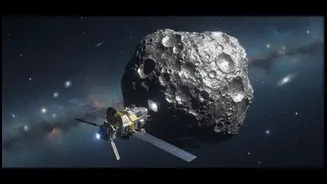
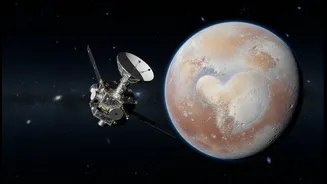
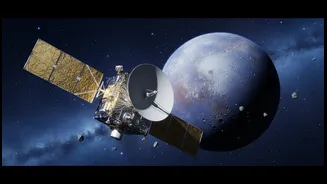
These discoveries make NASA's Psyche mission, which launched in October 2023 and recently used a Mars gravity assist in May 2026 to set its course, more exciting than ever. The spacecraft is scheduled to arrive at the asteroid in August 2029. While originally conceived as a journey to a metal world, the mission is now an investigation into a truly enigmatic object that defies easy categorization. The spacecraft's instruments, including a multispectral imager and spectrometers, are perfectly suited to map these surface variations in detail. By studying the mix of rock and metal up close, scientists will aim to determine which of the new formation theories is correct. The mission will provide ground truth to the telescope data and finally solve the puzzle of Psyche's origin.