

The Old View: A Quintillion-Year Lifespan
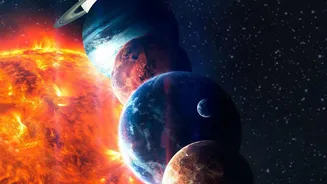
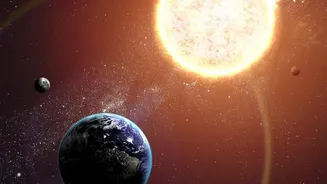
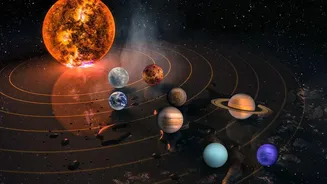
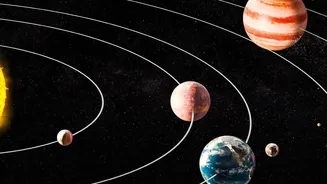
For decades, the consensus among astronomers was that the outer solar system was a place of immense stability. While the inner planets like Mercury, Venus, and Earth face a fiery doom when the Sun swells into a red giant in about five billion years, the gas
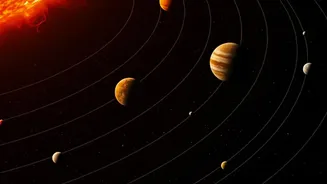
and ice giants—Jupiter, Saturn, Uranus, and Neptune—were expected to survive. Early calculations predicted they would continue their stately, near-circular orbits for an almost unimaginable length of time, perhaps a quintillion (a billion billion) years. Later estimates brought that figure down to a still-massive 100 billion years. The prevailing theory was that as the dying Sun lost mass, the giants' orbits would simply expand, and they would settle into a new, stable configuration, disturbed only by the rare gravitational pull of a passing star.
The Game Changer: A Messy Solar Death
A new study, published in The Astrophysical Journal Letters, throws a wrench in that tidy picture. Researchers ran hundreds of complex N-body simulations on supercomputers to model the solar system's distant future. The key difference from previous models was how they treated the Sun's end-of-life mass loss. Instead of assuming the Sun would shed its mass smoothly and predictably, the new simulations modeled a more realistic and chaotic process. They accounted for the Sun losing mass through random, uneven bursts as it transitions from a red giant to a white dwarf. These violent, episodic ejections create what scientists call 'stochastic kicks'—irregular gravitational nudges that can subtly, yet profoundly, alter the delicate balance of the outer planets.
A Future of Unpredictable Chaos
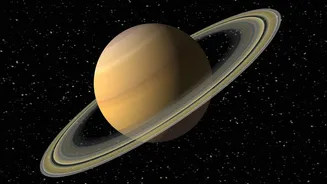
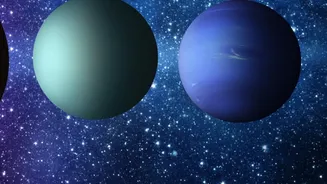
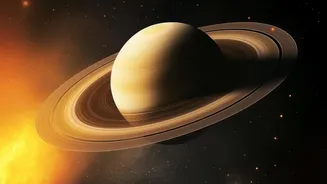
The results of these new simulations are dramatic. The long-held stability of the outer planets dissolves far sooner than ever expected. The study found that instead of lasting for quintillions of years, the outer solar system could descend into chaos within just one billion years after the Sun becomes a white dwarf. That’s a staggering reduction in its predicted lifespan. In about 40% of the simulations, the disruption began even earlier, while the Sun was still in its red giant phase. The outcomes were varied and violent: in some scenarios, Saturn was ejected from the solar system entirely. In others, the ice giants Uranus and Neptune were thrown into such disarray that they swapped places in their orbits. The once-orderly dance of the planets becomes a destructive gravitational pinball machine.
Why This Changes Our Cosmic Perspective
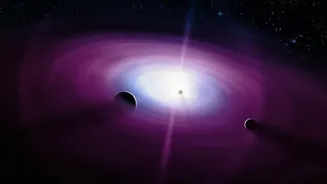
This research fundamentally alters our understanding of how planetary systems evolve and die. It suggests that the endstate of a solar system is not a gentle fading but can be a period of violent reconfiguration. While this cosmic drama will unfold long after Earth is gone, it has implications for what we might find around other stars. Astronomers looking for habitable planets around white dwarfs—the long dead cores of stars like our Sun—must now consider that any surviving planetary systems might be highly unstable. The seemingly placid orbits we see today are not guaranteed to last. The new findings underscore that even small, random events, compounded over billions of years, can lead to catastrophic changes, dismantling the very architecture of a solar system.