
Life in Complete Darkness
For most of history, we assumed all life on Earth depended on the sun. Photosynthesis, the process of turning sunlight into energy, forms the base of almost every food chain we know. But in 1977, scientists exploring the Galápagos Rift discovered something
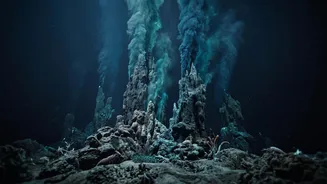
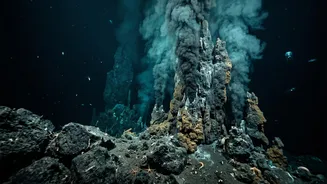
that shattered this assumption. More than two kilometers beneath the surface, where no sunlight can penetrate, they found bustling ecosystems. Around fissures in the seafloor called hydrothermal vents, which spew superheated, mineral-rich water, life was thriving. These communities were packed with giant tubeworms, ghostly white crabs, and dense mats of bacteria, all living in total darkness and under immense pressure. This discovery proved that life doesn't strictly need sunlight; it just needs a source of energy.
An Engine Called Chemosynthesis
The engine powering these deep-sea oases is called chemosynthesis. Instead of using sunlight, microbes at the base of the food web harness chemical energy. They metabolize compounds like hydrogen sulfide—which is toxic to most life on the surface—erupting from the vents. These bacteria use chemical reactions to create organic matter, effectively making their own food from the planet's internal heat and chemistry. This process forms the foundation of the entire vent ecosystem, with larger animals either eating the microbes or hosting them in a symbiotic relationship. The existence of chemosynthesis demonstrated that life could arise and prosper based on geology and water alone, a revelation that radically expanded our definition of a 'habitable' environment.
Oceans on Other Worlds
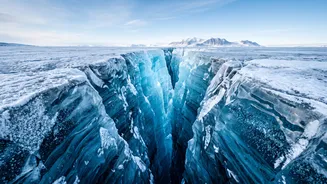
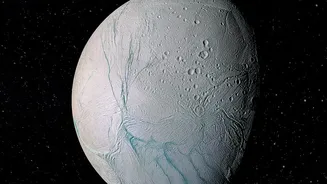
Meanwhile, decades of planetary exploration have revealed that Earth isn't the only 'ocean world' in our solar system. Jupiter's moon Europa and Saturn's moon Enceladus are covered in thick shells of ice, but strong evidence suggests they both hide vast, global oceans of liquid saltwater beneath. This water is kept from freezing by tidal heating—a process where gravitational tug-of-war with their giant parent planets stretches and flexes the moons' interiors, generating friction and heat. Scientists estimate Europa's ocean may contain more than twice the amount of water in all of Earth's oceans combined. On Enceladus, the Cassini spacecraft even observed geysers erupting through cracks in the ice, blasting water, ice particles, and organic molecules from the hidden ocean into space.
A Blueprint for Alien Life
This is where the two discoveries—deep-sea vents on Earth and deep oceans on icy moons—converge. The leading hypothesis for life on worlds like Europa and Enceladus doesn't involve creatures on the surface, but rather life in their subsurface oceans. If tidal forces are heating their rocky cores, it is plausible that these moons also have hydrothermal vents on their seafloors. These alien vents would release heat and chemical nutrients into the water, creating the exact same conditions that support chemosynthetic life on Earth. The discovery of hydrogen and silica particles in the plumes of Enceladus strongly points to active hydrothermal processes. Life could, in theory, exist there in total darkness, completely independent of sunlight, just as it does at the bottom of our own seas.
The Hunt for Answers
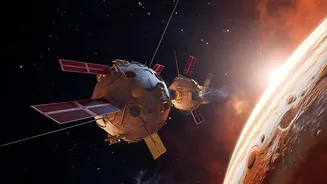
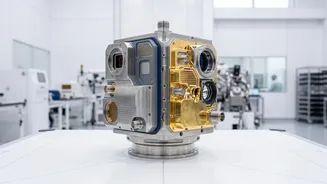
Confirming this theory is a primary goal of modern astrobiology. While no mission can yet drill through the miles of ice, current and future probes are designed to search for clues. NASA's Europa Clipper mission, which launched in October 2024, will perform dozens of close flybys of the moon to analyze its surface, confirm the ocean's properties, and even sample its thin atmosphere. It will use ice-penetrating radar to understand the structure of the ice shell and determine how the ocean interacts with the surface. Though not a life-detection mission itself, Europa Clipper's main goal is to assess whether the moon has the necessary conditions for life—water, chemistry, and energy—and to identify potential locations where evidence of that life might be found.