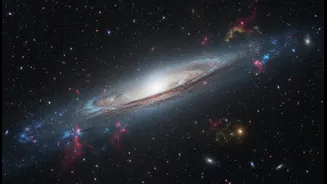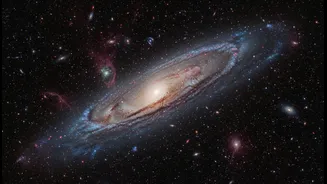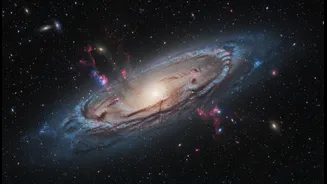





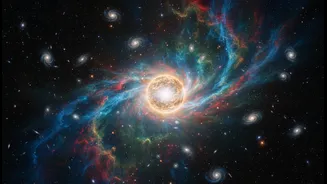


Meet Centaurus A: A Peculiar Neighbour
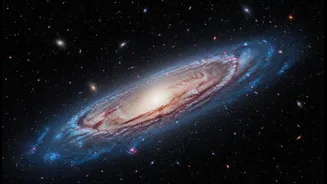
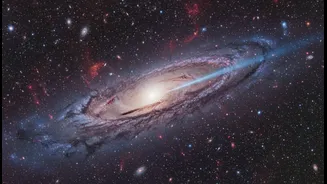
Imagine a galaxy that’s the result of a cosmic car crash. That’s Centaurus A. Located about 11 to 13 million light-years away, it’s relatively close to us in the vastness of space. Astronomers are fascinated by it because it has a strange, disturbed shape.
For years, the prevailing theory has been that Centaurus A, a large elliptical galaxy, collided with a smaller spiral galaxy a few hundred million to two billion years ago. This merger left behind a distinctive, dark lane of dust slashing across its bright centre, making it a dramatic sight. This collision also triggered a burst of intense star formation, earning it the label of a 'starburst' galaxy.
Webb’s Super-Vision Pierces the Dust
Previous telescopes like Hubble have given us beautiful images of Centaurus A, but they were limited. The thick dust lane in the galaxy's middle acts like a cosmic curtain, blocking visible light and hiding what lies within. This is where the James Webb Space Telescope becomes a superhero. Webb sees the universe in infrared light, which can pass straight through cosmic dust that would otherwise obscure the view. While the retired Spitzer telescope also saw in infrared, Webb's vision is far sharper, allowing it to see individual stars where Spitzer could only see large, blurry structures. This new image, released to celebrate four years of Webb's scientific operations, finally pulls back that dusty curtain, giving us an unprecedented look at the galaxy’s hidden heart.
Galactic Archaeology: A Story Written in Starlight
What Webb’s image reveals is nothing short of 'galactic archaeology'. For the first time, we can see millions of individual stars packed densely within the galaxy's core. Each of these stars is like a fossil, holding information about the galaxy's chaotic past. By studying them, astronomers can reconstruct a timeline of events: when the oldest stars formed, when the galactic collision sparked a new wave of star birth, and how the galaxy has evolved since. The grainy texture in Webb's image isn't a flaw; it's a tapestry of countless stars, each with a story to tell about this dramatic cosmic history.
The Monster in the Middle
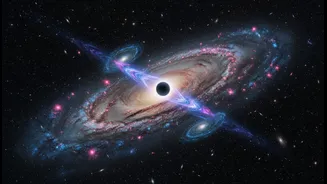
At the heart of Centaurus A lies a supermassive black hole, about 55 million times the mass of our Sun. This isn't a quiet giant; it's an active galactic nucleus, meaning it's actively feeding on gas and dust. As it eats, it unleashes powerful jets of energy that shoot out into space at nearly half the speed of light, shaping the entire galaxy around it. Webb's new observations are providing fresh clues about the complex relationship between a black hole and its host galaxy. It seems the black hole can both trigger star formation by compressing gas and shut it down by blasting away the raw materials with its powerful jets.
Why This Cosmic Portrait Matters to You
A picture of a galaxy millions of light-years away might feel distant, but it’s deeply connected to our own quest for knowledge. For young Indians aspiring to be scientists, engineers, and innovators, projects like the JWST are a powerful source of inspiration. They show what humanity can achieve through collaboration and curiosity. This image isn't just a pretty picture; it’s a data-rich field of discovery that will keep astronomers busy for years, solving puzzles about how galaxies like our own Milky Way form and evolve. It’s a reminder that there are vast, incredible frontiers still to explore, and the tools we build today are writing the textbooks of tomorrow.