







A Symphony of Ten Parachutes
When the Gaganyaan crew module returns to Earth, it relies on far more than a single canopy. The deceleration system is a complex, meticulously sequenced array of ten parachutes of four distinct types, all working in concert. The process begins with two
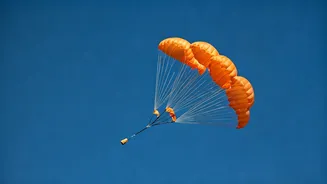
Apex Cover Separation parachutes, which jettison the protective heat shield covering the main parachute compartment. Next, two high-strength Drogue Parachutes deploy. These smaller, ribbon-style chutes are crucial for stabilizing the capsule at high speeds and reducing its velocity significantly. They prevent tumbling and ensure the module is correctly oriented for the final, most critical phase of descent. Only then are three Pilot Parachutes released, which in turn are responsible for extracting the three massive Main Parachutes. This entire sequence is a high-stakes mechanical ballet where every step must be flawless.
Recreating Re-entry From Kilometres High
To prove the system works, ISRO cannot simply wait for a real mission. Instead, it conducts a series of Integrated Air Drop Tests (IADT). In these exercises, a Crew Module Mass Simulator—a dummy capsule weighing the same as the real thing—is carried to a high altitude, often around 2.5 to 3 kilometres, by an Indian Air Force transport aircraft like the IL-76 or a Chinook helicopter. The capsule is then dropped. This simulates the conditions the actual capsule will face during the final phase of its return. As the module plummets, onboard systems trigger the entire parachute deployment sequence. Hundreds of sensors record every detail, from the force on the parachute lines to the stability of the descent, providing engineers with invaluable data to validate their designs.
Intentionally Simulating Failure
Testing the limits means planning for what could go wrong. The system is built with redundancy, meaning two of the three main parachutes are sufficient for a safe landing, with the third acting as a backup. The simulations are designed to test this. During some drop tests, engineers deliberately create failure scenarios, such as one of the main parachutes failing to open. This allows them to confirm that even in a partial failure, the remaining parachutes can handle the increased load and bring the crew module to a safe splashdown speed. Recent tests, such as the Integrated Main Parachute Airdrop Test (IMAT) series, focus specifically on qualifying the main parachutes for the maximum load they could ever be expected to endure during a mission. These tests stress the system beyond normal parameters to guarantee a wide safety margin.
Abort Scenarios: The Ultimate Safety Net
The parachute system is not just for a normal return; it is the final act in any emergency abort scenario. If a problem occurs on the launchpad, a Pad Abort Test (PAT) has proven the Crew Escape System can fire rockets to pull the capsule away from the danger. Similarly, if the rocket fails mid-flight, an In-flight Abort Test (like the TV-D1 mission) shows the capsule can be jettisoned to safety. In both of these critical escape manoeuvres, after the capsule is propelled to a safe distance, it is the parachute system that takes over, deploying in its precise sequence to ensure the crew’s survival and a gentle landing in the sea. These abort simulations prove that the parachutes are the ultimate guarantee for bringing the astronauts home, no matter what happens during launch.
A National Collaboration for Safety
The development and testing of this critical system is a testament to national collaboration. The project is jointly managed by the Indian Space Research Organisation (ISRO), particularly the Vikram Sarabhai Space Centre (VSSC), and the Defence Research and Development Organisation (DRDO), with its specialised labs like the Aerial Delivery Research and Development Establishment (ADRDE) and Terminal Ballistics Research Laboratory (TBRL). The Indian Air Force provides the aircraft and pilots for the crucial drop tests, while the Indian Navy is tasked with the complex operations to recover the capsule from the sea after splashdown. Each successful test is a milestone achieved through the coordinated efforts of India's premier scientific, military, and engineering institutions, all focused on a single, non-negotiable goal: astronaut safety.