





The Astronauts on Board
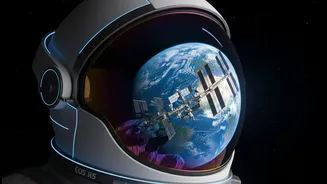
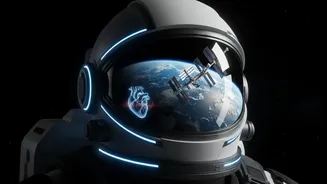
Right now, as you read this, a crew of seven astronauts is living and working 400 kilometres above Earth. The current crew, known as Expedition 74, includes astronauts from NASA (the American space agency), Roscosmos (the Russian space agency), and ESA
(the European Space Agency). They are a mix of veteran space-flyers and first-timers. Their daily lives are a packed schedule of conducting science experiments, maintaining the station, and even going on spacewalks. Following the astronauts on social media or through NASA's website is a great way to see what life is like for our human representatives in orbit.
Cool Science in Zero Gravity
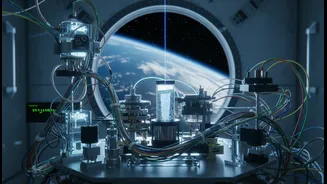
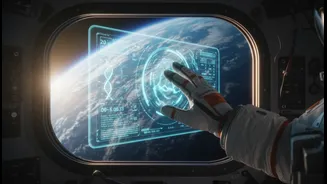
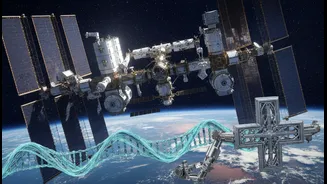
The ISS isn't just a home; it's a one-of-a-kind laboratory. Without gravity, scientists can study things in ways that are impossible on Earth. Right now, the crew is working on some amazing projects. One experiment is focused on engineering cartilage tissue, which could lead to better treatments for joint injuries back on Earth. Others are studying how microgravity affects blood pressure and the human body, knowledge that is crucial for future long-duration missions to the Moon and Mars. The station has hosted over 4,000 experiments that have led to breakthroughs in medicine, materials science, and our understanding of the universe.
India's Leap Towards the Stars
While India is not one of the five main partners of the ISS, the country's own space ambitions are reaching new heights. The Indian Space Research Organisation (ISRO) is working hard on its Gaganyaan mission, which aims to send Indian astronauts, called Gaganyatris, into orbit. Recent tests of the mission's parachute systems and rocket motors have been successful, moving India closer to becoming only the fourth country to send humans to space independently. The first crewed flight is targeted for 2027. Australia recently announced it will set up a tracking station to support the Gaganyaan mission, showing the growing international support for India's space programme.
The Beginning of the End
All good things must come to an end, and the ISS is scheduled for retirement around 2030. After more than 30 years of continuous operation, the station will perform a final, carefully controlled manoeuvre. It will be guided to re-enter Earth's atmosphere over a remote part of the South Pacific Ocean known as Point Nemo, sometimes called the 'spacecraft cemetery'. As it descends, most of the station will burn up due to the intense heat from air friction, with some larger pieces expected to fall into the ocean, far from any populated areas. A special deorbit vehicle, supplied by SpaceX, will help push the massive structure on its final journey.
The Next Generation of Space Stations
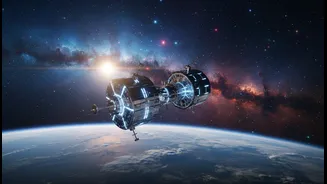
The end of the ISS does not mean the end of living in orbit. In fact, it marks the beginning of a new era of commercial space stations. NASA plans to be a customer, buying services from private companies instead of owning the station itself. Several companies are developing new orbital outposts. Axiom Space is building modules that will first attach to the ISS and later detach to become a free-flying station. Other companies like Blue Origin, Starlab, and Vast are also developing their own commercial space habitats. These new stations will be hubs for research, manufacturing, and even space tourism.
How to Spot the Station Yourself
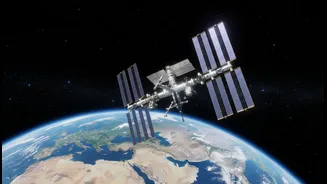
Did you know you can see the ISS from your own backyard? You don't even need a telescope. Because it reflects sunlight, the station appears as a very bright, steady point of light moving quickly across the night sky. It looks like a fast-moving airplane but without any flashing lights. The best times to see it are at dawn or dusk. NASA's Spot the Station website and app make it incredibly easy. You just enter your location, and it will tell you exactly when and where to look up to catch a glimpse of this football-field-sized marvel as it silently soars overhead at 28,000 km/h.