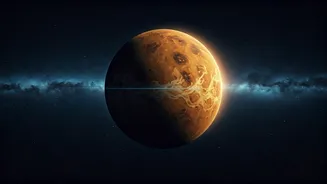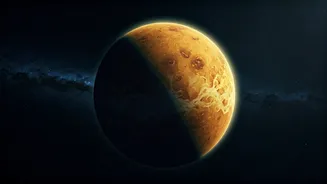






A Year Shorter Than a Day
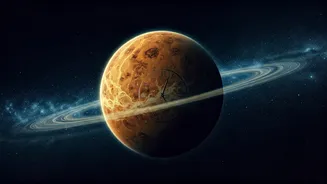
Let’s break down this mind-bending concept with some numbers. Venus takes approximately 225 Earth days to complete one full orbit around the Sun. This is its year. However, it takes a staggering 243 Earth days for Venus to complete just one rotation on its axis.
This single spin is its day (a sidereal day, to be precise). So, if you were standing on the surface of Venus, you would celebrate your 'New Year' before you’d even experienced a full 'day' from the planet's perspective. This makes Venus the only planet in our solar system with a day longer than its year. It’s an extreme case of planetary weirdness that sets it apart from Earth, where our 365-day year is neatly divided by 24-hour days.
The Slow, Backward Spin
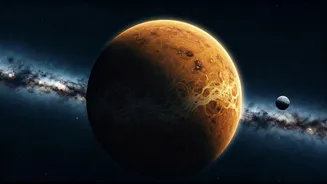
The puzzle of Venus gets even stranger when you look at the direction of its spin. Nearly every planet in our solar system, including Earth, rotates on its axis in a counter-clockwise direction (prograde motion). This is the same direction in which they orbit the Sun. But Venus is a rebel. It spins clockwise, a phenomenon known as retrograde rotation. The only other major planet that does this is Uranus, which is tilted so far on its side it practically rolls along its orbit. On Venus, this backward spin means the Sun would appear to rise in the west and set in the east. This unusual rotation is a key piece of the puzzle in understanding its incredibly long day.
Why The Cosmic Go-Slow?
So, why is Venus such a slow, backward spinner? Scientists don't have a single definitive answer, but two leading theories offer compelling explanations. The first is the 'giant impact' hypothesis. Early in the solar system's history, a planet-sized object may have slammed into Venus, not only slowing its rotation to a crawl but also flipping it upside down, causing the retrograde spin. A cataclysmic event of this scale would have fundamentally altered the planet's destiny. The second major theory points to Venus's incredibly thick and heavy atmosphere. This dense blanket of carbon dioxide, about 90 times thicker than Earth's, could be acting like a powerful brake. The friction between the solid planet and its massive, churning atmosphere, combined with solar tides, may have gradually slowed Venus's rotation over billions of years.
A Runaway Greenhouse Nightmare
Venus's slow rotation and thick atmosphere are inextricably linked to its hellish surface conditions. The planet is a textbook example of a runaway greenhouse effect. Its dense carbon dioxide atmosphere traps heat so efficiently that surface temperatures average a scorching 465° Celsius—hot enough to melt lead. The atmospheric pressure at the surface is over 90 times that of Earth's, equivalent to being nearly a kilometre deep in our ocean. This toxic, crushing environment is a direct consequence of the atmospheric dynamics that may also be responsible for the planet's sluggish spin. In many ways, Venus serves as a cautionary tale of how a planet’s climate can evolve to an extreme, uninhabitable state.
What a 'Day' on Venus Feels Like
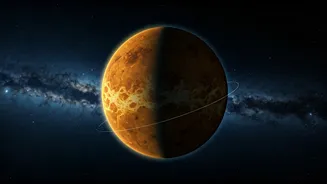
While its rotational day is 243 Earth days long, the time from one sunrise to the next on Venus (a solar day) is different due to its orbit around the Sun. Because of the retrograde spin, a solar day on Venus is actually about 117 Earth days long. This means for nearly two months, one side of the planet bakes under the relentless Sun, while the other side is plunged into a two-month-long night. Even during the long night, temperatures barely drop due to the insulating effect of the thick clouds. It's a world of extreme, drawn-out cycles, completely alien to the rhythmic rise and fall of day and night we take for granted on Earth.