





The Importance of Location
The story of planetary rings begins with an invisible boundary in our solar system known as the 'frost line'. Located between the current orbits of Mars and Jupiter, this line marks the distance from the Sun where it is cold enough for volatile compounds
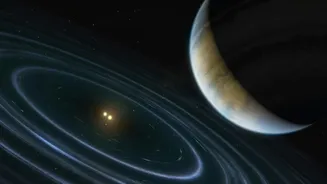
like water, ammonia, and methane to freeze into solid ice. Inside this line, closer to the Sun's heat, these compounds could only exist as gas and were largely blown away by the solar wind. This left behind only rock and metal to form the smaller, terrestrial planets: Mercury, Venus, Earth, and Mars. Beyond the frost line, however, the vast cold allowed these abundant icy materials to condense and accumulate, providing the raw materials for both the massive gas giants and their spectacular ring systems.
The Power of Gravity and the Roche Limit
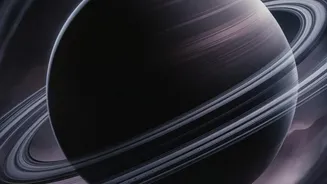
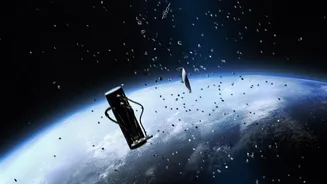
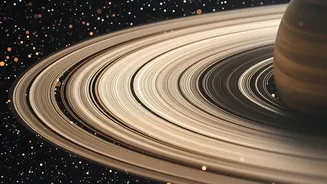
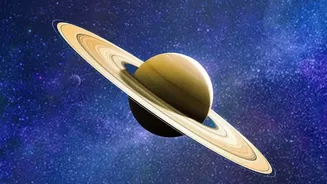
The second crucial ingredient is immense gravity. The gas giants—Jupiter, Saturn, Uranus, and Neptune—are colossal compared to their rocky siblings. Their powerful gravitational fields allow them to attract and capture passing comets, asteroids, or even their own moons. This is where a critical concept called the Roche limit comes into play. First calculated by astronomer Édouard Roche in 1848, the Roche limit is the distance from a planet within which the planet's tidal forces are so strong they can overcome the gravitational force holding a smaller body, like a moon, together. If a moon or a large comet wanders inside this limit, the planet's gravity will literally tear it apart, shredding it into countless smaller pieces. These shattered fragments then spread out into orbit, forming a ring. Nearly all known planetary rings in our solar system exist within their parent planet's Roche limit.
Shepherding the Flock
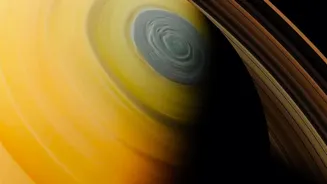
Forming a ring is one thing; maintaining it is another. Without a stabilising influence, ring particles would eventually disperse. This is where 'shepherd moons' play a vital role. These are small moons that orbit near the edges of a ring, or within gaps in the rings. Their gravitational pull acts like a cosmic sheepdog, herding the particles and keeping them confined in a narrow, well-defined band. The gravity of a shepherd moon can either speed up stray particles, pushing them back into the ring, or slow them down, causing them to fall back into a lower orbit within the ring system. Saturn's famous, narrow F ring, for example, is kept in place by the shepherd moons Prometheus and Pandora.
Why the Inner Planets Miss Out
So why are the inner planets ringless? They fail on almost every count of the ring-making recipe. Firstly, they are on the wrong side of the frost line, where the primary ingredient for brilliant rings—ice—could not survive in large quantities. Any rings would have to be made of rock, which is less common in the form of small, stray bodies. Secondly, their gravity is much weaker. While Earth has a Roche limit (around 18,000 kilometres), it is much smaller, and our Moon orbits far beyond it. We simply don't have the gravitational might to capture and destroy large objects as effectively as the gas giants. It is theorised that Earth may have had a temporary rocky ring billions of years ago, formed from the debris of a massive impact that also created our Moon. However, this material was outside the Roche limit and quickly coalesced to form the single, stable satellite we see today.