





A World Tour Every 90 Minutes
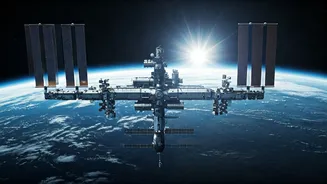
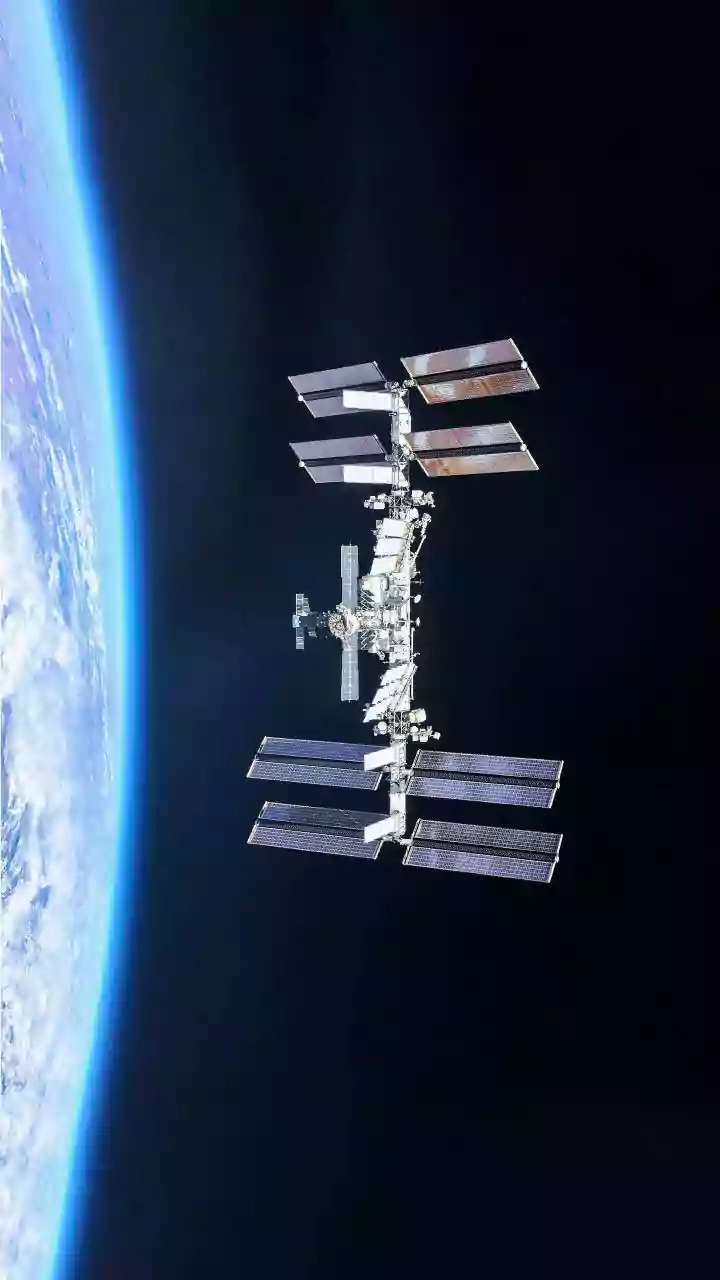
The detail that frequently sends ripples of awe across the internet is this: the International Space Station travels at a staggering speed of roughly 28,000 kilometres per hour. This incredible velocity means it completes a full orbit of Earth approximately
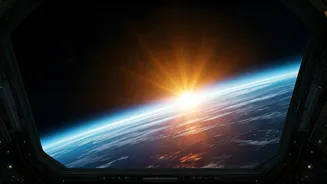
every 90 minutes. For the astronauts on board, this translates into a truly mind-bending reality: they witness 16 sunrises and 16 sunsets every single day. While we on the ground experience a single cycle of day and night, the crew of the ISS hurtles through nearly a dozen and a half, each sunrise a brilliant flash of light that lasts only a few seconds.
The Science of Staying Aloft
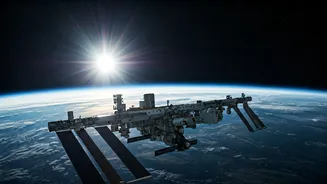
How does the ISS maintain this incredible speed without flying off into deep space or burning up in the atmosphere? The answer lies in a delicate balance of physics. The station exists in a state of perpetual freefall. It is constantly falling toward Earth due to gravity, but its immense forward momentum—its orbital velocity—is so fast that it continuously “misses” the planet. The curve of its fall matches the curve of the Earth. It orbits in the thermosphere, an upper layer of the atmosphere about 400 kilometres up, where there are far too few air particles to cause the kind of friction and heat that burns up meteors. This balancing act allows it to remain in a stable orbit, racing around the globe as a testament to human ingenuity.
Life With 16 Sunrises
Living in an environment with such a rapid day-night cycle presents unique challenges for the human body. Our internal clocks, or circadian rhythms, are wired for a 24-hour cycle. To counter this, the space station operates on a standardised time zone—Coordinated Universal Time (UTC), which is equivalent to Greenwich Mean Time. Astronauts follow a strict schedule to regulate their sleep and work periods, ensuring they get a proper night's rest despite the 16 fleeting sunsets outside their windows. This temporal distortion is just one of the many adaptations required for life off-planet, where the rhythms of Earth no longer apply.
The Best View in the Solar System
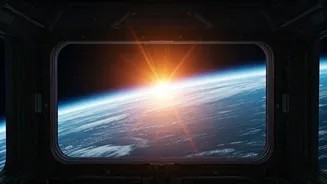
When astronauts have free time, they often flock to the same spot: the Cupola. This seven-windowed, dome-shaped module is the station's panoramic observation deck, offering breathtaking views of Earth. It is from here that crew members witness the planet's beauty, track weather patterns, and observe the thin, fragile blue line of our atmosphere against the blackness of space. This experience often leads to a profound cognitive shift known as the 'overview effect'—a feeling of awe and interconnectedness with humanity and the planet as a whole. Seeing Earth without borders or political divisions often gives them a new perspective on the world they left behind.
Why This Fact Continues to Fascinate
The ISS has been continuously inhabited since November 2000, serving as a laboratory for thousands of scientific experiments. Yet, it is the simple, visceral detail of its speed and the 16 daily sunrises that continues to be shared by enthusiasts. Why? Because it serves as a powerful and easily understood metric of what humanity has achieved. It contrasts our familiar, grounded experience of time and space with a radically different reality that is happening just a few hundred kilometres above our heads. It reframes our understanding of a 'day' and transforms the ISS from an abstract scientific outpost into a place of profound wonder. This single fact reminds us that a small group of people is living in a future we once only dreamed of, taking a planetary victory lap every hour and a half.