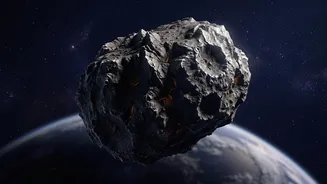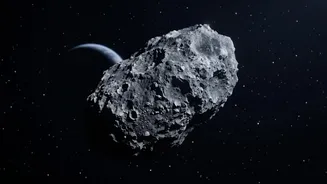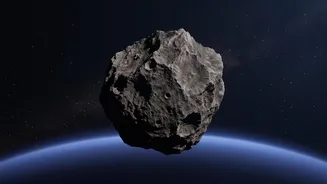


In the vast emptiness of space, most objects follow predictable paths governed by gravity. But a small, fast-spinning asteroid known as 1998 KY26 is breaking the rules, and its strange acceleration is forcing a major rethink of a popular theory.
Meet the Cosmic Speedster
Discovered
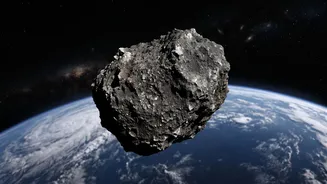
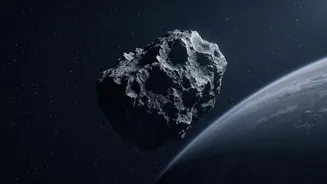
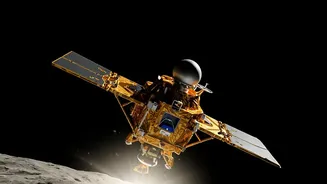
in 1998, 1998 KY26 is a tiny near-Earth asteroid, measuring only about 11 metres (36 feet) in diameter. Despite its small size, it has captivated scientists for two main reasons. Firstly, it rotates incredibly fast, completing a full spin in just over five minutes. Secondly, it is the target of an extended mission for Japan's Hayabusa2 spacecraft, which is scheduled to rendezvous with the asteroid in July 2031. This encounter will make 1998 KY26 the smallest asteroid ever visited by a space probe, offering a unique chance to study these small but significant celestial bodies up close. The mission is crucial not just for pure science, but for planetary defence, as understanding the composition and behaviour of such objects helps us prepare for any potential impact threats.
The Dark Comet Hypothesis
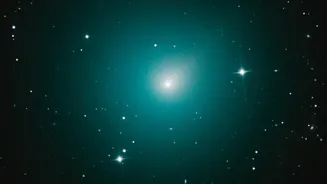
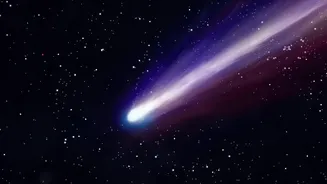
For a time, scientists had a compelling theory to explain 1998 KY26's unusual movement. Its orbit showed a slight but definite acceleration that could not be explained by gravity alone. This led to the 'dark comet' hypothesis. A comet gets a push, or non-gravitational acceleration, from ice turning into gas and escaping its surface, a process known as outgassing. A 'dark' or 'dormant' comet is an object that has lost most of its surface ice, or has it sealed under a crust, so it doesn't have a visible tail but still experiences this subtle push from faint outgassing. Because 1998 KY26's acceleration seemed to fit this pattern, it was classified as a potential dark comet.
A Theory Thrown into Doubt
However, recent research has cast serious doubt on this explanation. A new study from aerospace engineers at the Georgia Institute of Technology, published in the journal Icarus, used computer models to analyse the asteroid's temperature. They found that even the coldest parts of 1998 KY26 are far too warm to hold onto buried water ice. According to their calculations, the asteroid's orbit-averaged temperature is significantly above the sublimation point where ice turns directly into gas in a vacuum. Any significant amount of water ice would have vanished in just a few thousand years—and the ice needed to cause its current acceleration would be gone in a mere 62 years. This finding strongly suggests that outgassing from water ice is not the cause of its mysterious push.
What Else Could Be at Play?
If not a dark comet, then what is causing 1998 KY26 to speed up? The answer may lie in forces that, while tiny, have a significant effect on small bodies over long periods. One leading candidate is the Yarkovsky effect. This happens when an asteroid absorbs sunlight and then re-emits that energy as heat. This emission is not perfectly even, creating a minuscule but constant thrust that can alter an object's orbit over millennia. A 2025 reanalysis of the asteroid's trajectory showed that its non-gravitational acceleration could be fully explained by the Yarkovsky effect, given its updated size and properties. This paints a picture of 1998 KY26 not as a dormant, icy body, but as a solid, rocky object being gently nudged by sunlight.
Awaiting a Close-Up
The debate highlights just how much we have to learn about the small objects zipping through our cosmic neighbourhood. While thermal models and orbital calculations provide strong evidence, the ultimate answers will come from direct observation. The Hayabusa2 mission is therefore more critical than ever. When it arrives in 2031, its instruments will analyse the asteroid's surface composition, structure, and density. This will provide definitive proof of whether it is a solid rock, a loosely-bound 'rubble pile', or something else entirely. One speculative, though unproven, theory even suggests it could be the lost Soviet spacecraft Phobos 1, due to similarities in size and reflectivity. Whatever Hayabusa2 finds, its visit to this tiny, accelerating world promises to solve one mystery while opening new windows into the evolution of our solar system.