




A Glimmer of Hope in the Cosmos
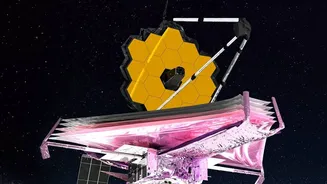
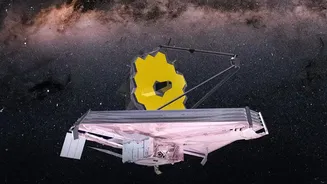
The James Webb Space Telescope has captured what scientists have long been searching for: the chemical signature of water vapour in the atmosphere of a rocky world outside our solar system. One of the most compelling recent findings involves GJ 486 b,
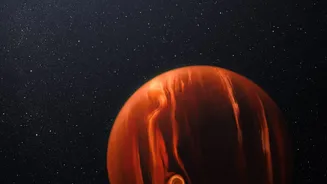
a 'super-Earth' about 30% larger than our own planet, located 26 light-years away. Observations from Webb's Near-Infrared Spectrograph (NIRSpec) revealed features that suggest the presence of an atmosphere containing water. This is a landmark moment. While water has been detected on giant gas planets before, finding it on a rocky planet—a world with a solid surface like Earth or Mars—is a far more significant milestone in our quest to find potentially habitable environments. The discovery hints that even planets in extreme conditions might be able to hold onto an atmosphere, a key ingredient for life.
How Webb Reads a Planet's Air
So, how does the JWST detect something as specific as water from light-years away? It uses a technique called transmission spectroscopy. Think of it like a cosmic filter. When an exoplanet passes in front of its host star from our point of view, a tiny fraction of the starlight shines through the planet's atmosphere. The gases in that atmosphere absorb specific colours, or wavelengths, of light. By capturing the starlight with and without the planet in front, astronomers can see which colours are missing. These missing slivers in the light spectrum act as a chemical fingerprint. The specific pattern detected from worlds like GJ 486 b corresponds to the signature of water (H2O), giving scientists a clue about the composition of its air.
A Steamy World, Not an Oasis
Before we imagine oceans and rivers, it's crucial to understand the context. The planet GJ 486 b orbits its red dwarf star in less than two days and has a scorching surface temperature of about 430 degrees Celsius. It is far too hot to host liquid water or life as we know it. However, the presence of any atmosphere at all is what's truly exciting. Planets this close to their stars are bombarded with intense radiation, which is expected to strip away their atmospheres. Finding evidence of water vapour suggests that this rocky world might have a process, such as volcanic activity, that is constantly replenishing its atmosphere from within. This is what scientists call a 'secondary atmosphere'.
A Scientific Puzzle
The discovery is not without its complexities. Scientists are cautious, noting another possibility: the water signal might be coming from the star itself. The host star, GJ 486, is a cool red dwarf, and its surface can have cool 'starspots' that contain water vapour. It's a scientific puzzle to distinguish whether the telescope detected a planetary atmosphere or a feature on the star's surface. Researchers are now planning further observations with other Webb instruments, like the Mid-Infrared Instrument (MIRI), to look at the planet's day side. If the planet has an atmosphere, it should circulate heat, making the day side cooler than a bare rock would be. This follow-up data will be key to confirming the discovery.
The Search Continues
This finding is part of a broader effort by the JWST, which is revolutionising our understanding of exoplanets. The telescope is also studying planet-forming disks, like the one around the young star PDS 70, where it has found water vapour in the very region where rocky planets are expected to form. This implies that worlds similar to Earth could have water available to them from the very beginning of their formation. While discoveries around planets like 55 Cancri e have pointed to atmospheres rich in carbon dioxide or carbon monoxide, the hunt for water remains a top priority. Each detection, whether confirmed or tentative, provides invaluable clues about how common Earth-like conditions might be across the galaxy.