
More Than Meets the Eye
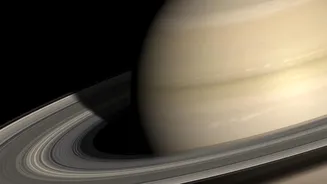
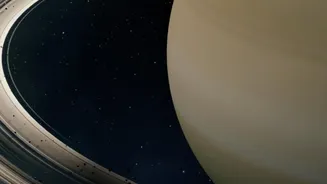
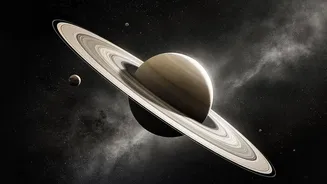
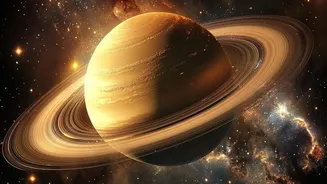
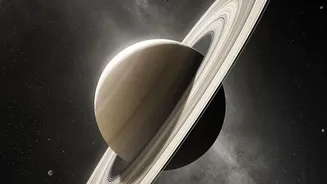
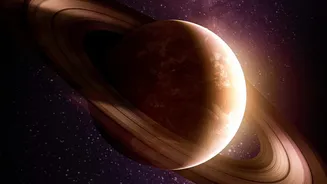
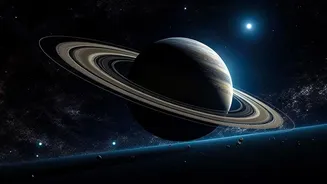
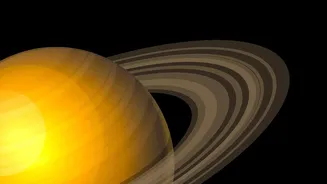
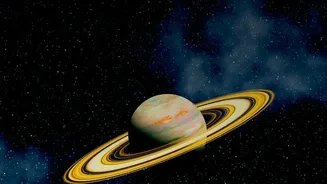
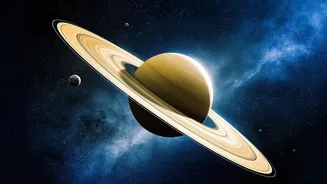
From Earth, Saturn’s rings appear as a serene, stable halo of light. In reality, they are a bustling, chaotic system of countless icy particles, ranging in size from microscopic dust to mountain-sized boulders, all orbiting the gas giant at incredible
speeds. For decades, scientists believed this system was largely separate from the planet itself. However, observations from missions like Voyager and, more recently, NASA’s Cassini spacecraft have revealed a far more intimate and violent relationship. It turns out the rings are constantly feeding material into Saturn’s upper atmosphere, a phenomenon colorfully dubbed “ring rain”. This isn't a gentle cosmic drizzle; it's a significant downpour that has a profound effect on the planet's chemistry and climate.
A Surprising Chemical Cocktail
One of the biggest surprises came from data collected during Cassini's “Grand Finale” in 2017, when the probe made 22 daring dives between the planet and its innermost rings before plunging into the atmosphere. Since the rings are known to be about 99% water ice, scientists expected the ring rain to be almost pure water. Instead, Cassini’s instruments found a complex chemical cocktail. Water made up only about 24% of the material, with the rest being a surprising mix of methane, ammonia, carbon monoxide, and various organic molecules. This discovery was a shock, suggesting the processes at play are far more complicated than previously imagined. It’s not just ice falling into the planet; it’s a stream of complex chemistry that could be altering the composition of Saturn’s upper layers. The sheer volume was also stunning, with estimates suggesting as much as 10,000 kilograms of this material hammers into Saturn every second.
The Core of the Mystery
These findings have opened up a host of new questions. For one, why is the composition of the ring rain so different from the overall composition of the rings themselves? Scientists are still working to model the forces that could be separating these materials. Another mystery is the effect this influx has on Saturn’s atmosphere. This rain of particles is believed to be responsible for heating the planet's upper atmosphere in ways the distant Sun cannot explain. It also appears to be “quenching” Saturn’s ionosphere, reducing the density of charged particles in the regions where it falls, which explains long-standing anomalies observed for decades. Understanding this interaction is crucial because it directly impacts the lifespan of the rings. At the current rate of loss, the entire magnificent ring system could disappear in as little as 100 million years—a blink of an eye in cosmic terms.
A Race Against Time
The revelation that Saturn’s rings are temporary has added a new urgency to this field of study. It suggests that we are incredibly lucky to be alive in an era when they are so prominent. Other gas giants in our solar system, like Jupiter and Neptune, have only faint, wispy ringlets, and it's possible they once sported grand systems like Saturn's that have long since faded. The debate now also includes the age of the rings. Their pristine, icy nature suggests they might be young, perhaps only 100 million years old, formed from a shattered moon or a captured comet. This is a stark contrast to older theories that they formed with the planet over 4 billion years ago. The rate of this ring rain is a key piece of evidence in this ongoing debate.
The Search for Answers Continues
Although the Cassini mission has ended, the mountain of data it sent back will keep scientists busy for decades. Researchers are meticulously re-analyzing its final measurements and combining them with observations from the Hubble Space Telescope to build a more complete picture. They are trying to understand how factors like Saturn's seasons and magnetic field influence the rate and composition of the ring rain. Each discovery not only tells us more about Saturn but provides a unique laboratory for understanding how planetary systems form and evolve across the galaxy. The unexpected and intricate dance between Saturn and its rings is a powerful reminder that even in our own solar system, there are fundamental mysteries waiting to be solved.