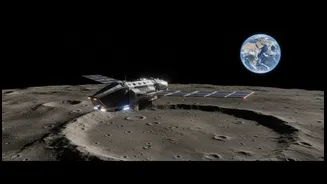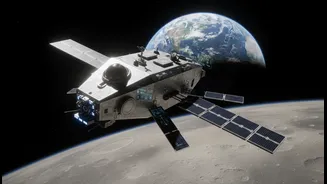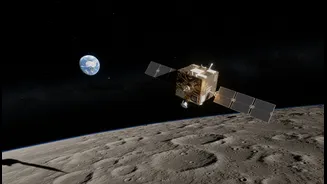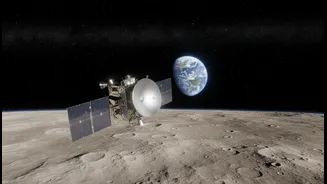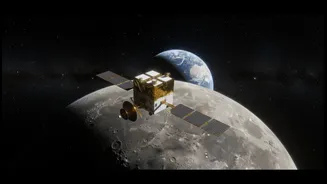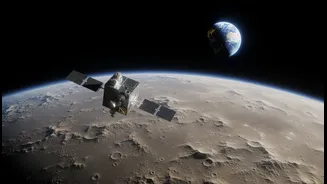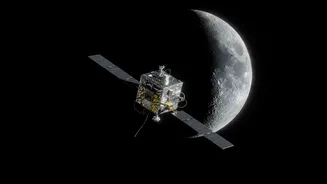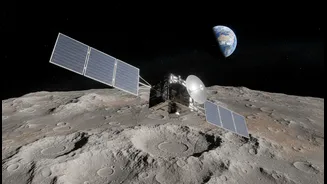




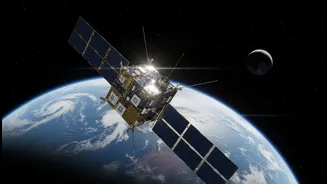
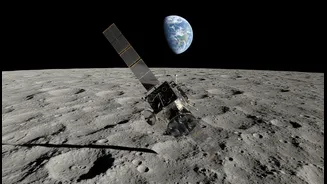
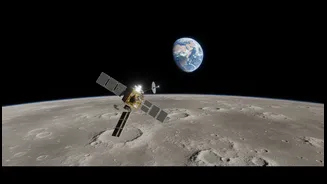


What Was CAPSTONE?
CAPSTONE, short for Cislunar Autonomous Positioning System Technology Operations and Navigation Experiment, was a 55-pound CubeSat with a Texas-sized mission. Launched in June 2022, its main goal wasn't to study the Moon itself, but to test how to get
there and stay there in a smarter way. Owned and operated by Advanced Space of Colorado, the mission was a key example of a public-private partnership designed to accelerate space technology at a lower cost. After achieving all its primary and extended goals, NASA's official involvement concluded in June 2026, marking the successful end of a nearly four-year technological demonstration.
A Groundbreaking Lunar Orbit
One of CAPSTONE's most critical tasks was to be the first spacecraft to fly in a unique and challenging path called a Near-Rectilinear Halo Orbit (NRHO). This highly elongated orbit is special because it exists at a gravitational balance point between the Earth and the Moon. This stability means spacecraft in an NRHO need very little fuel for long-term missions, making it the ideal parking spot for the future Lunar Gateway space station—a key component of NASA's Artemis program. CAPSTONE's success proved that this orbit, once just a theory in simulations, is a viable and efficient highway for future lunar operations.
The Dawn of Autonomous Navigation
Perhaps the mission's most significant achievement was demonstrating a revolutionary GPS-like navigation system for deep space. The Cislunar Autonomous Positioning System (CAPS) software allowed CAPSTONE to determine its own position without constant instructions from Earth. The system was tested by communicating directly with NASA's Lunar Reconnaissance Orbiter (LRO), using the orbiter as a reference point much like a cell phone uses multiple towers to triangulate its location. This breakthrough is crucial for a busier lunar future, as it frees up ground-based antennas and allows spacecraft to operate more independently.
A Pathfinder for Artemis
The data and experience gained from CAPSTONE are invaluable for NASA's Artemis program, which aims to establish a sustained human presence on the Moon. By verifying the stability of the NRHO, CAPSTONE has reduced the risks for the Lunar Gateway, which will serve as a command center and staging point for astronauts traveling to the lunar surface. Furthermore, the autonomous navigation technologies tested by CAPSTONE will be essential for the complex choreography of landers, rovers, and orbiting spacecraft that will make up a permanent lunar base.
A New Model for Space Missions
CAPSTONE wasn't just a technical success; it was a programmatic one. The mission proved that small, relatively low-cost CubeSats, developed in partnership with commercial companies, can serve as powerful pathfinders for massive exploration programs. Advanced Space will continue to operate the spacecraft as a technology testbed, but NASA's initial investment has already paid off, providing a wealth of data that will inform mission design for years to come. This model allows the agency to test new, high-risk technologies without launching expensive, flagship-class satellites for every experiment.