



The Persistent Problem of Cloudy Days
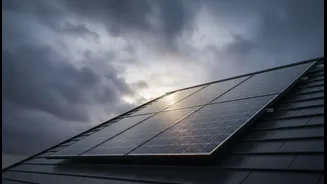
Solar energy has become a cornerstone of India's renewable ambitions, with vast solar farms and rooftop panels sprouting across the country. Yet, every year, the arrival of the monsoon season highlights solar power’s core vulnerability: it doesn't work
well without the sun. Conventional photovoltaic (PV) panels convert sunlight directly into electricity. While they can still produce some power from indirect or scattered light on overcast days, their output drops significantly. During heavy rain or at night, production ceases altogether. This intermittency is a major challenge for grid stability and makes solar a less reliable primary power source, often requiring expensive battery storage systems to bridge the gap. For a nation that experiences several months of intense cloud cover and rainfall, this limitation has always been a significant hurdle in the path towards complete energy independence.
Harnessing the Power of Raindrops
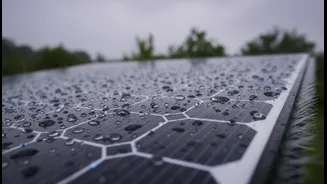
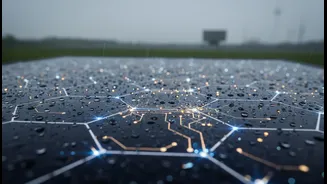
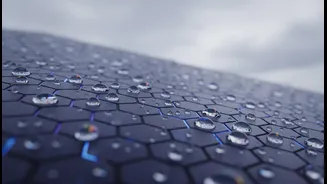
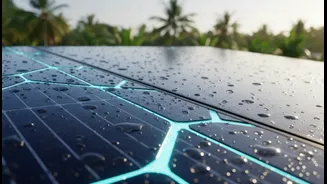
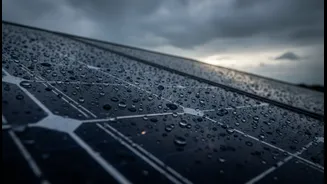
Imagine a solar panel that welcomes the rain. This is the promise of a groundbreaking technology being developed by researchers around the world, from Soochow University in China to the Institute of Materials Science of Seville (ICMS) in Spain. The innovation lies in creating a hybrid device that combines a standard solar cell with a new, transparent layer called a triboelectric nanogenerator, or TENG. This TENG layer is designed to harvest the kinetic energy from falling raindrops. Essentially, it turns the panel into an all-weather power plant that can generate electricity from both sunshine and showers. It’s a solution that doesn’t see rain as a problem, but as another resource to be tapped.
How It Works: The Science of Friction
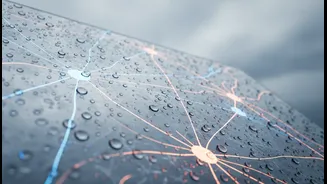
The principle behind the TENG is the triboelectric effect — the same phenomenon that creates static electricity when you rub a balloon on your hair. Scientists have developed an ultra-thin, transparent film, sometimes just nanometres thick, to place over a solar cell. When a raindrop hits this specially coated surface and slides down, the friction between the water and the film causes an exchange of electrons, creating a small electrical charge. This charge is then captured by electrodes and converted into usable electricity. Researchers have demonstrated that the impact from a single raindrop can generate a surprisingly high voltage, in some cases over 100 volts, which is enough to power small electronic devices. Because the polymer layers are transparent, they don't significantly reduce the amount of sunlight reaching the solar cell underneath, allowing the panel to function efficiently in both sunny and rainy conditions.
A Breakthrough for Monsoon Climates
The implications of this technology for India are immense. An all-weather solar panel could fundamentally change the reliability of renewable energy, especially during the monsoon. Instead of production plummeting during the rainiest months, these hybrid panels would continue to supply power to the grid, smoothing out the seasonal fluctuations that currently challenge energy planners. This could reduce the reliance on fossil fuel backup generators and make solar power a more consistent and predictable part of the nation's energy mix. While not yet powerful enough to replace the output from direct sun, the energy from rain could power essential low-power devices, keep batteries topped up, and contribute to overall grid stability when sunlight is scarce. This makes renewable energy more practical and economically viable in regions with frequent rainfall.
The Road from Lab to Rooftop
Despite the exciting progress, you won't be able to buy a rain-harvesting solar panel for your home just yet. The technology is still in the research and development phase. Scientists are working to overcome several key challenges. One is improving the power output of the TENG component, which is currently quite low compared to the solar cell. Another is ensuring the durability of the delicate nanogenerator layers over a 20- to 25-year lifespan in harsh weather conditions. The primary material for the solar cell component, perovskite, is known for its high efficiency but also for its vulnerability to moisture—a paradox that researchers are solving with new protective coatings that also serve as the TENG layer. Early applications will likely be for low-power remote sensors in agriculture or infrastructure monitoring before the technology is scaled up for residential and commercial use.