



Beyond Earthly Forecasts
For centuries, weather has been a strictly local, terrestrial affair. Now, that's changing. NASA is spearheading a new chapter in exploration focused on planetary meteorology: the study of atmospheres and weather patterns on other worlds. This isn't just
a matter of curiosity; it's a fundamental expansion of what we know about how planets work. The primary driver of this new era is a fleet of advanced robotic explorers. The James Webb Space Telescope (JWST) is a game-changer, powerful enough to analyse the chemical makeup of atmospheres on exoplanets hundreds of light-years away by seeing what kind of starlight they absorb. It can detect clouds, water vapour, and map temperature differences across these distant worlds. Closer to home, rovers like Perseverance act as sophisticated weather stations on Mars, providing daily reports on temperature, wind, and dust. These tools are giving us our first real look at the cosmic climate report.
A Tour of Solar System Weather
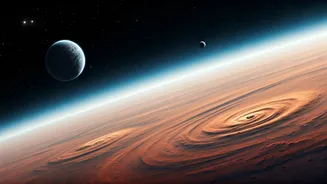
The weather across our solar system is far more extreme and varied than anything on Earth. On Mars, the Perseverance and Curiosity rovers have measured bone-chilling temperatures that can swing by over 80 degrees Celsius from day to night. They also track the planet's infamous dust devils and global dust storms, which can envelop the entire planet and are a critical factor for planning future human missions. Looking at Saturn's largest moon, Titan, we find a world with a thick nitrogen atmosphere and a weather cycle that mirrors Earth's, but with a twist. Instead of water, Titan has rivers, lakes, and rain made of liquid methane and ethane. NASA's upcoming Dragonfly mission, a nuclear-powered rotorcraft, will fly through Titan's skies in the 2030s to study this bizarre methane cycle up close, offering clues into prebiotic chemistry.
Exoplanets and Extreme Climates
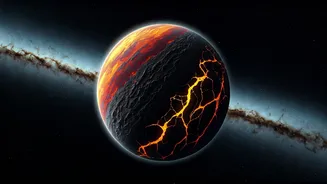
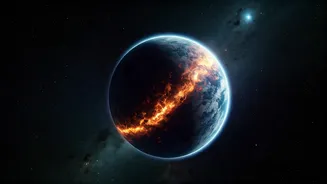
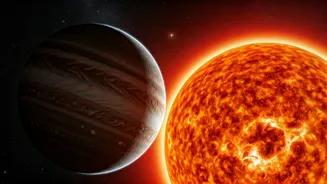
As fascinating as our neighbours are, the most extreme weather is found on exoplanets. Using the JWST, astronomers are discovering worlds straight out of science fiction. There are so-called 'hot Jupiters' orbiting incredibly close to their stars, with one side permanently baked and the other in darkness. On one such planet, WASP-121b, it's believed to rain liquid gems at night. On another, scientists have detected clouds made of quartz nanocrystals that vaporise on the scorching dayside and reform on the nightside. Other discoveries point to planets where it may rain molten iron or even glass, whipped around by supersonic winds. By studying the light that filters through these alien atmospheres, scientists can map weather patterns, such as morning cloud blankets that burn off by evening, providing a truly dynamic view of exoplanet climates.
A Mirror to Our Own World
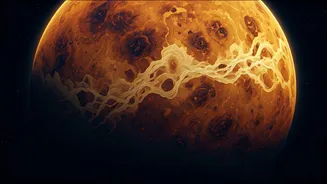
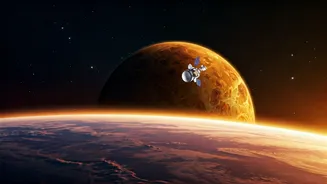
So, why does weather on a planet 700 light-years away matter to us? The answer lies in a field called comparative planetology. By studying how different atmospheres behave under different conditions, scientists can test and refine the climate models they use to understand Earth. Venus, with its runaway greenhouse effect, serves as a stark warning of what can happen to a planet's climate. Mars, which lost its once-thicker atmosphere and water, provides a case study in atmospheric escape. Understanding these planetary-scale experiments helps us grasp the forces shaping our own world's climate change. Every piece of data, whether from a Martian dust storm or clouds on an exoplanet, provides another piece of the puzzle, helping us understand the past, present, and future of Earth's climate in a galactic context.