



Defining a Day and a Year
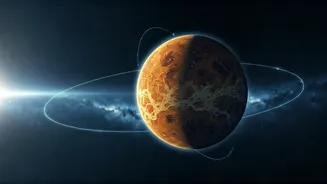
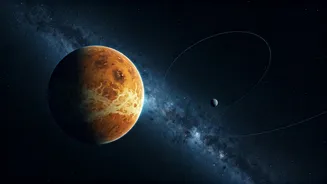
To understand this cosmic paradox, we first need to clarify what a ‘day’ and a ‘year’ mean for a planet. A year is simply the time it takes for a planet to complete one full orbit around its star. For Earth, that’s about 365 days. Venus, being closer
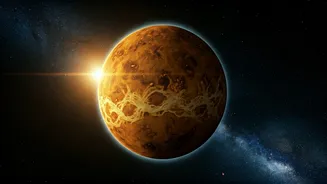
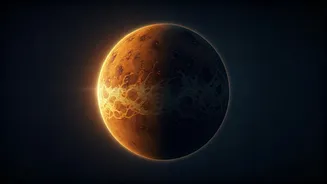
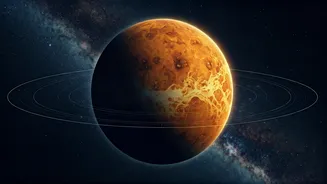
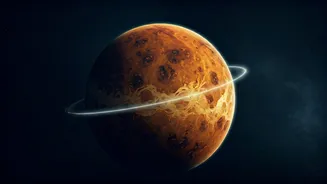
to the Sun, zips around it much faster, completing its orbit in just about 225 Earth days. So, one Venusian year is 225 Earth days long. A ‘day’, however, refers to an axial spin—the time it takes for a planet to rotate once on its own axis. Earth does this in about 24 hours. Venus, on the other hand, is the solar system’s slowest spinner. It takes a mind-boggling 243 Earth days to complete a single rotation. When you compare the two numbers, the bizarre truth becomes clear: its 225-day year is shorter than its 243-day rotational period.
The Slowest, Strangest Spin
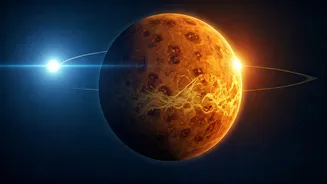
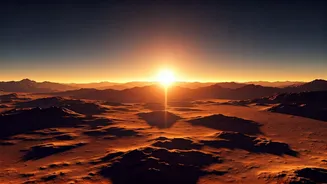
Venus’s rotation isn't just incredibly slow; it’s also backward. Every other planet in our solar system (except for Uranus, which spins on its side) rotates in the same direction it orbits the Sun, a direction known as prograde. This is why on Earth, the Sun rises in the east and sets in the west. Venus, however, has a ‘retrograde’ rotation. If you could stand on its surface, you would see the Sun rise in the west and set in the east. This combination of an incredibly slow and backward spin makes Venus a true outlier among planets. Its sluggishness is extreme; a person could literally walk faster than the planet rotates at its equator.
Why Is Venus So Different?
Scientists are still debating the exact cause of Venus’s strange rotation. One leading theory suggests a colossal impact in its distant past. Billions of years ago, a massive planet-sized object might have slammed into Venus, not only slowing its rotation to a crawl but also flipping its axis upside down, causing the retrograde spin. Another powerful theory points to its incredibly thick and heavy atmosphere. Venus’s atmosphere is about 90 times denser than Earth’s, creating immense surface pressure. This dense, soupy air could be creating so much friction with the surface that it has acted as a powerful brake over billions of years, gradually slowing the planet’s spin. It’s also possible that a combination of factors, including gravitational tugs from the Sun and other planets, contributed to this unique state.
A Day in a Hellish Life
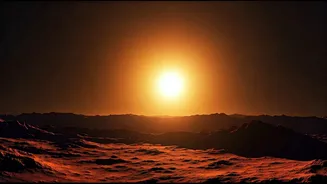
So, what would this long day feel like? Because the planet is rotating so slowly while also orbiting the Sun, the length of a single day-night cycle (a ‘solar day’) is different from its rotational period. On Venus, the time from one sunrise to the next is about 117 Earth days. This means for nearly two months, one side of the planet bakes under the relentless Sun, while the other side is plunged into an equally long night. This slow cooking, combined with a runaway greenhouse effect from its carbon dioxide-rich atmosphere, makes Venus the hottest planet in the solar system. Surface temperatures hover around a scorching 465°C, hot enough to melt lead. It’s a toxic, crushing, and blisteringly hot world where our concepts of time simply fall apart.