





A Visitor from Beyond
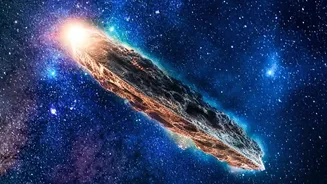
Imagine a rock, forged in the orbit of a distant star, ejected into the void, and left to drift through the space between stars for millions, or even billions, of years. That, in essence, is an interstellar object. These celestial travelers are exceptionally
rare finds. While our solar system is full of comets and asteroids that originated here, spotting one from another star system is a landmark event. On July 1, 2025, astronomers using the ATLAS survey telescope in Chile found just that. The comet was named 3I/ATLAS, with the '3I' designating it as the third interstellar object ever confirmed, following the discoveries of 1I/'Oumuamua in 2017 and 2I/Borisov in 2019.
The Telltale Signs of an Outsider
So, how did scientists know 3I/ATLAS wasn't from around here? The clues were in its speed and its path. The comet was traveling at an incredible velocity—around 137,000 miles per hour when discovered—and moving along a path known as a hyperbolic trajectory. Unlike the elliptical, or oval-shaped, orbits of objects bound to our Sun, a hyperbolic path is an open-ended, one-way trip. 3I/ATLAS was moving too fast to be captured by the Sun's gravity, proving it was just passing through. It approached from the direction of the constellation Sagittarius and, after swinging past our Sun in late October 2025, is now heading back out into the vastness of interstellar space, never to return.
A Time Capsule from Another World
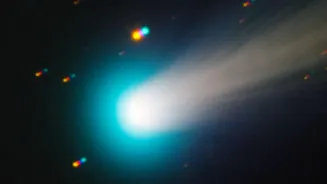
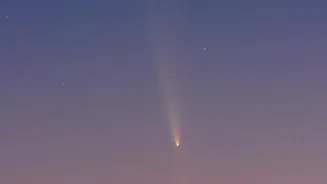
What makes 3I/ATLAS so compelling is that it's a pristine sample of another solar system. As it neared our Sun, its ices began to heat up and turn to gas, creating a glowing cloud, or coma, around its nucleus. By studying the light from this coma using powerful tools like the James Webb and Hubble Space Telescopes, scientists can determine its chemical makeup. Initial findings have been fascinating. 3I/ATLAS was found to be unusually rich in carbon dioxide, suggesting it may have formed in an extremely cold region of its home star system. Unlike the mysterious, rocky 'Oumuamua, 3I/ATLAS is clearly a comet, complete with a coma and tail, which gives scientists much more material to analyze.
Potentially the Oldest Object Ever Seen
Recent studies have yielded an even more stunning possibility. Based on its trajectory and composition, some researchers have suggested that 3I/ATLAS could be ancient—perhaps up to 12 billion years old. This would make it nearly three times the age of our own solar system and one of the oldest objects ever observed. Its path suggests it may have originated from the Milky Way's "thick disk," a region populated by ancient stars. If true, this comet isn't just a sample from another star system; it's a relic from the early history of our galaxy, offering clues about how planetary systems might have formed billions of years ago.
Why These Visitors Matter
While 3I/ATLAS posed no threat to Earth, passing about 170 million miles away at its closest, its scientific importance is immense. Every piece of data gathered helps us understand if the building blocks of planets and life are common throughout the galaxy. By comparing 3I/ATLAS to comets from our own Oort cloud, astronomers can piece together the story of cosmic evolution. The discovery of three interstellar objects in less than a decade, thanks to improving telescope survey technology, suggests we may be entering a new era of astronomy. These fleeting guests are no longer just theoretical possibilities but observable facts, each one carrying secrets from its stellar home.