




The Illusion Everyone Sees
You're not imagining it. The moon low in the sky looks colossal compared to when it's high overhead. This phenomenon, known as the Moon Illusion, has puzzled humanity for thousands of years, with even ancient Greek philosophers trying to explain it. Early
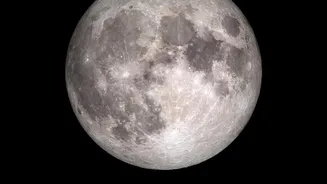
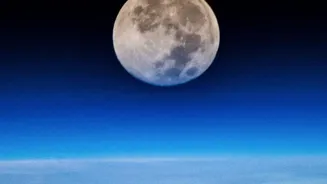
theories suggested the Earth's atmosphere might be acting like a magnifying glass. However, modern science and simple photography have proven this wrong. If you take a picture of the horizon moon and then another of the zenith moon (when it's high up) with the same camera settings, the moon is the exact same size in both photos. In fact, the moon is technically about 1.5% farther away from you when it's on the horizon, so it should appear slightly smaller, not larger. The magnificent size you perceive is a powerful and convincing illusion, created entirely within your brain.
Your Brain Is The Magician
The leading explanation for the Moon Illusion is a fascinating trick of perception called the Ponzo Illusion. First described by Italian psychologist Mario Ponzo, this illusion demonstrates how our brain judges an object's size based on its perceived distance. Imagine two identical lines drawn on a set of converging train tracks. The line that appears farther down the tracks will look longer than the closer one, even though they are the same length. Your brain uses the converging tracks as a distance cue, telling itself, 'If two objects have the same retinal size, but one seems farther away, the farther one must be physically larger'. This size-constancy scaling is something our brains do constantly and automatically to make sense of the 3D world.
The Power of Horizon Cues
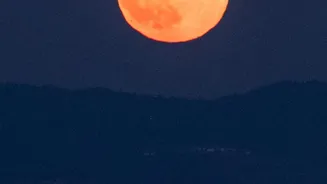
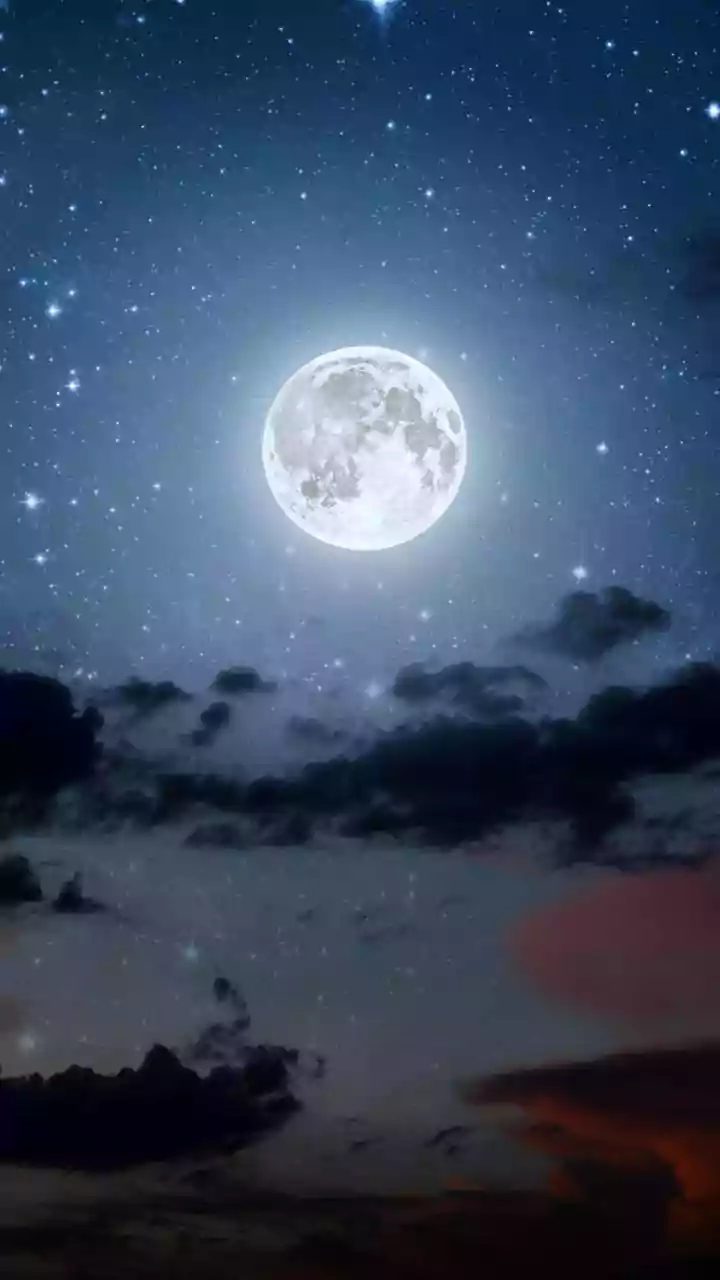
This is where the 'environmental horizon cues' from the headline come in. When the moon is near the horizon, your view is filled with familiar objects that provide depth and distance information: trees, buildings, mountains, and the texture of the landscape itself. Your brain sees the moon sitting behind these objects and interprets it as being very far away. Because it seems so distant, your brain, applying the same logic as the Ponzo Illusion, concludes that it must be enormous to appear the way it does. When the moon is high overhead, these terrestrial cues vanish. It's just a bright disc in a vast, empty expanse of sky. With no reference points to establish distance, your brain perceives the sky overhead as being much closer than the sky at the horizon. Without the distance cues telling it otherwise, your brain doesn't feel the need to scale up the moon's size, so it appears smaller.
Why October's Moon Feels Special
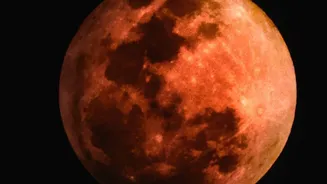
The October full moon, known as the Hunter's Moon, often provides a perfect stage for this illusion. Occurring on October 26 in 2026, it rises around sunset, just as the landscape is silhouetted against the fading light. This creates a dramatic contrast and plenty of horizon cues for our brains to process. The beautiful orange or reddish colour of the rising moon is a separate, real phenomenon. It’s caused by the moon's light travelling through more of Earth's atmosphere, which scatters the shorter, blue wavelengths and lets the longer, red wavelengths pass through. This atmospheric filtering enhances the visual drama but isn't part of the size illusion itself. The combination of the real colour change and the perceived size increase makes the Hunter's Moon rise an especially memorable event.
Test the Illusion Yourself
You can easily prove to yourself that the moon's size doesn't change. The next time you see a giant moon on the horizon, hold a small object like a pea or a coin at arm's length and see how it compares to the moon's diameter. You can even just use the tip of your pinky finger at arm's length. Wait a few hours until the moon is high in the sky and appears smaller. Do the same thing. You will find that it covers the exact same amount of your finger or the coin. Your eyes and your brain will be telling you two different stories, but the coin doesn't lie. It's a simple, effective way to experience the powerful disconnect between physical reality and our own perception.