


The Oxygen Problem on Mars
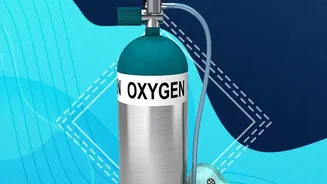
Breathing is just the beginning. While a crew needs oxygen to live, the largest demand comes from the rocket needed to leave Mars and return to Earth. Launching a Mars Ascent Vehicle requires tens of tons of liquid oxygen to act as a propellant oxidizer.
Transporting all that oxygen from Earth is logistically and financially staggering; for every ton of payload landed on Mars, it takes about 12 to 13 tons of mass launched into Earth's orbit. The only viable solution is to make it there, a concept called In-Situ Resource Utilization (ISRU). This means living off the land, turning the Red Planet’s resources into breathable air and rocket fuel.
A Proof of Concept: MOXIE
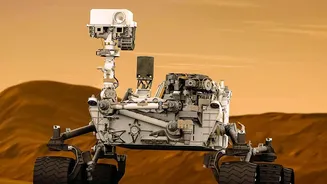
NASA has already proven this is possible with the Mars Oxygen In-Situ Resource Utilization Experiment, or MOXIE. A small, microwave-sized instrument aboard the Perseverance rover, MOXIE has successfully produced oxygen by inhaling the thin Martian atmosphere, which is 95% carbon dioxide (CO2). It heats the CO2 to about 800°C and uses an electrochemical process called solid oxide electrolysis to split the molecules, producing pure oxygen (O2) and carbon monoxide (CO) as a byproduct. Since 2021, MOXIE has generated small but vital quantities of oxygen, proving the fundamental science works on another world.
The Power-Hungry Leap to Human Scale
MOXIE is a brilliant success, but it's a technology demonstrator. It produces only about 10-12 grams of oxygen per hour, enough for an astronaut to breathe for maybe 15 minutes. A full-scale system to support a human crew and fuel their ascent vehicle would need to be hundreds of times larger and more productive, operating continuously for over a year to produce the required 25-30 metric tons of oxygen. This industrial-scale chemical plant would require a massive and constant supply of power—somewhere in the range of 25-30 kilowatts. The rover's power source, which powers MOXIE, is nowhere near sufficient for this task.
Enter the Advanced Nuclear Reactor
This is where advanced reactors come in. To meet the high energy demands, NASA is developing compact fission power systems through its Fission Surface Power project. These are small, portable nuclear reactors designed to provide tens of kilowatts of reliable power, day and night, regardless of weather or dust storms. The term "carbon reactor" in the headline likely refers to advanced designs like high-temperature gas-cooled reactors, which can use carbon-based materials like graphite in their construction. These advanced systems are designed to be safe, efficient, and robust enough for the harsh Martian environment, serving as the essential power station for an entire outpost.
A Two-Part System for a New World
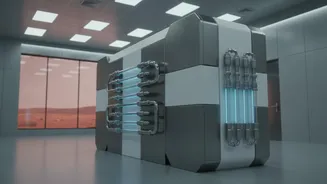
The future of Mars exploration, therefore, relies on a powerful partnership. An advanced fission reactor will land on Mars, likely ahead of any human crew, to begin generating power. This reactor will then energize a scaled-up, industrial-sized version of MOXIE. This oxygen factory will work tirelessly, filling storage tanks with breathable air for the habitat and, most importantly, liquid oxygen for the rocket that will one day carry astronauts back home. It’s a two-part solution to one of space exploration's greatest challenges: the reactor makes the power, and the chemical plant makes the air. Without the steady, high-wattage output of a nuclear system, scaling oxygen generation for a human mission remains in the realm of science fiction.