





The Dance of the Planets
While the fast-moving meteors have faded, the steadfast glow of planets takes centre stage in the late August sky. The star of the show is Saturn. The ringed planet is well-placed for viewing and can be seen for several hours during the late night and into
the early morning. It shines with a steady, yellowish light. Not far behind is Mars, the Red Planet, which is also a relatively bright and high target in the pre-dawn sky. For those with patience and a clear eastern horizon, Jupiter makes an appearance shortly before sunrise, though it will be low and may be challenging to spot in the morning twilight. These planets offer a different kind of wonder—a chance to gaze upon entire other worlds from your own backyard. While a telescope reveals Saturn's famous rings, both it and Mars are easily visible to the naked eye, appearing as exceptionally bright, untwinkling stars.
Chasing the Milky Way's Core
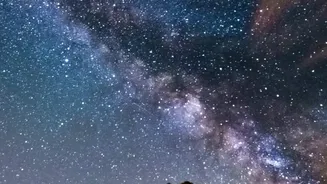
Late summer offers a precious window to witness one of the grandest sights imaginable: the core of our own galaxy, the Milky Way. From a truly dark location, it appears as a hazy, luminous band of light stretching across the sky. To find it, look south for the constellations Scorpius, with its distinctive J-shape, and Sagittarius, whose brightest stars form a pattern resembling a teapot. The galactic centre lies just beyond the 'spout' of the teapot, appearing as the densest and brightest part of the Milky Way. The biggest challenge in August is, of course, the monsoon. Cloud cover can frustrate even the most dedicated stargazer. However, the period right after a heavy rain shower can offer exceptionally clear skies, as the downpour washes dust and pollutants from the atmosphere. If you get a clear night, seize the opportunity. Desert regions like the Thar in Rajasthan or high-altitude areas like Ladakh and Spiti offer the most reliable chances to escape the clouds.
The Summer Triangle Overhead
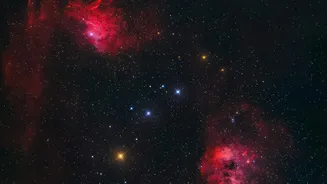
For an easy and rewarding target, look almost directly overhead. You’ll find the Summer Triangle, an asterism (a pattern of stars, not an official constellation) formed by three of the brightest stars in the sky: Vega, Deneb, and Altair. Vega, in the constellation Lyra, is typically the brightest of the three. Deneb, part of Cygnus the Swan, and Altair, in Aquila the Eagle, complete the large, distinct triangle. These stars are so luminous that they can be spotted even from light-polluted urban areas, making them a perfect starting point for city-bound observers. The Summer Triangle is a prominent feature of the northern hemisphere's summer and early autumn sky, serving as a reliable celestial landmark to help you navigate your way to other, fainter constellations.
Tips for the Best Viewing Experience
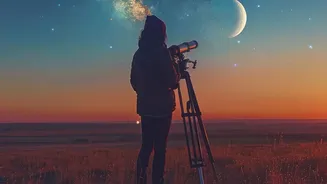
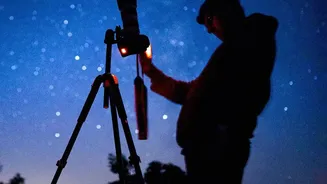
Your stargazing success depends heavily on your setup and location. The single most important factor is getting away from city lights. Ambient light pollution washes out faint objects like the Milky Way and subtler constellations. Even a short drive to a darker park or rural area can make a world of difference. Once you've found your spot, give your eyes at least 15-20 minutes to fully adapt to the darkness. Avoid looking at your phone screen, as its bright light will instantly ruin your night vision. If you need a light, use a red-light torch. While many sights are visible to the naked eye, a simple pair of binoculars can dramatically enhance your view. Scanning the Milky Way with binoculars reveals a breathtaking field of countless stars, and you might even be able to spot the four largest moons of Jupiter, appearing as tiny pinpricks of light next to the planet. Finally, consider using a stargazing app on your phone (in night mode!) to help identify what you're seeing in real-time.