
NASA's Plan: A Village on the Moon
NASA's Artemis program is a monumental shift from temporary visits to establishing a long-term human presence on the Moon. The plan involves creating a sustained outpost near the lunar South Pole, a region believed to hold water ice, a critical resource
for life support and rocket fuel. This Artemis Base Camp will be a hub for science and exploration, but building and sustaining it is a task too large for any single nation. The program is being executed in phases, with the current phase focusing on robotic missions to map the terrain, test technologies, and reduce risks before astronauts establish a more permanent footing. This collaborative approach is where the global community, including India, comes in.
What Exactly Is the 'Lunar Economy'?
The lunar economy refers to a future ecosystem of commercial activities on and around the Moon. This isn't just science fiction; projections estimate its value could reach well over $100 billion in the coming decades. Key sectors include the transportation of cargo and crew, the mining of lunar resources like rare minerals and helium-3 for clean energy, and the construction of infrastructure like habitats and landing pads. It also encompasses in-space manufacturing, data services, communication networks, and even niche areas like tourism and agriculture. Essentially, it's about creating a self-sustaining economic zone that supports human life and scientific discovery, while also generating value for Earth.
India's Seat at the Table: The Artemis Accords
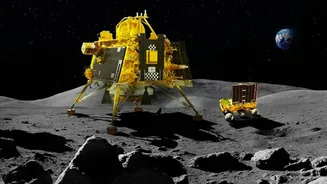
India formally entered this new era of space cooperation by signing the Artemis Accords in June 2023, becoming the 27th signatory. These accords are a set of principles for safe, transparent, and sustainable civil space exploration, creating a framework for international partnership in the Artemis program. This move signals a strategic shift for India, moving from a largely independent space power to a key collaborator in a major global initiative. Bolstered by the credibility of ISRO's successful missions like Chandrayaan-3, which made India the first nation to land on the lunar South Pole, the signing paves the way for deeper integration with NASA and other partner nations.
A Launchpad for Indian Innovation
The real opportunity for India lies in its burgeoning private space sector. In recent years, policy reforms have opened the floodgates for private enterprise, leading to the creation of over 400 space startups. The Indian space economy, currently valued at around $8.4 billion, is projected to grow to over $40 billion by 2033. These agile and innovative companies excel in areas crucial for the lunar economy. India is globally recognized for its cost-effective engineering, a massive advantage in an industry where launch costs are a primary barrier. This 'frugal innovation' model, proven by ISRO's remarkably low-cost missions, can be leveraged by private firms to offer competitive solutions.
The Key Sectors for Indian Contribution
Indian companies are well-positioned to become critical suppliers in the lunar supply chain. The opportunity extends far beyond just launching rockets. Startups are already developing capabilities in satellite manufacturing, propulsion systems, ground station services, and data analytics. Specific contributions could include developing rover components, creating robust and affordable communication systems, providing software for mission management and data analysis, and manufacturing parts for habitats and other infrastructure. Companies like Skyroot Aerospace, Agnikul Cosmos, and Pixxel are already making waves, securing international contracts and demonstrating advanced capabilities in launch vehicles and satellite imaging.