





The Great Global Marathon
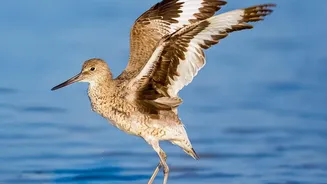
Imagine running a marathon not for hours, but for days or weeks on end, covering thousands of kilometres. This is the reality for many shorebird species, from the tiny sandpiper to the elegant godwit. Their migratory routes, or flyways, are some of the most
impressive journeys in the animal kingdom, connecting breeding grounds in the Arctic with non-breeding areas as far south as South America and Australia. But these incredible flights are not non-stop. To survive, the birds must make critical pit stops at coastal wetlands and mudflats to rest and refuel. The timing of these breaks is a matter of life and death, and it is perfectly synchronised with a powerful, ancient rhythm: the coastal tides.
A Race Against the Tide
For a migrating shorebird, a coastal stopover is a giant, all-you-can-eat buffet, but one with strict opening and closing times. The menu consists of marine invertebrates like worms, molluscs, and crustaceans that live buried in the mud and sand of intertidal zones. This buffet only becomes accessible at low tide, when the receding water exposes vast flats for the birds to forage. As the tide comes in, these feeding grounds are submerged, and the birds must retreat to safer, higher ground to rest until the water recedes again. Missing this window means missing a crucial meal, jeopardizing their ability to build up the energy reserves needed to complete their arduous journey. The birds' activity is therefore dictated by the tide's schedule, not necessarily the 24-hour cycle of day and night.
The Bird's Inner Clock
So, how do they do it? The secret lies in a remarkable internal timekeeper known as a biological clock. Just as humans have an internal 24-hour 'circadian' clock that governs our sleep-wake cycles, many coastal animals, including shorebirds, possess an additional 'circatidal' clock. This internal rhythm is naturally tuned to the approximate 12.4-hour cycle of the tides. This innate mechanism allows a bird to anticipate when the tide will be low, even before it arrives at a new stopover location. In a sense, they carry the rhythm of the ocean within them. This phenomenon is a powerful evolutionary adaptation, ensuring they are primed and ready to feed the moment their coastal buffet opens for business.
Syncing with Local Time
While an innate clock provides the basic rhythm, it must be fine-tuned to local conditions. Tidal schedules vary from one coastline to another. When shorebirds arrive at a new stopover site, their internal clock needs to synchronise with the local ebb and flow. Scientists believe they use a combination of environmental cues to make this adjustment. The sight of the expanding or contracting shoreline, the sound of the surf, and perhaps even subtle changes in air pressure can act as 'zeitgebers', or time-givers, that reset their internal circatidal clock. This allows them to quickly adapt their feeding and resting patterns to maximise their refuelling efficiency before they continue their migration. While many birds feed during the day, a significant number of shorebird species feed more regularly and in higher numbers at night, further showing their behaviour is linked to tide cycles rather than just daylight.
A Fragile and Threatened System
This incredible synchronization of internal biology and external environment is a finely tuned system, but it is also a fragile one. The coastal habitats that these birds depend on are under increasing threat from human activity. Development along coastlines often targets the upper portions of tidal zones, which are the very first areas to become available for foraging birds as the tide goes out and the last places they can rest at high tide. The loss of these crucial upper intertidal areas forces birds into a smaller, more crowded space for a shorter period, disrupting their ability to feed effectively. Climate change also poses a threat, as rising sea levels can permanently submerge these vital feeding grounds. The disruption of these stopover sites doesn't just inconvenience the birds; it breaks a critical link in their migratory chain, with potentially devastating consequences for their populations.