



A New Eye on the Cosmos
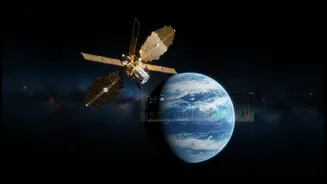
Launched as a collaboration between NASA, the European Space Agency, and the Canadian Space Agency, the James Webb Space Telescope (JWST) is the most powerful space observatory ever built. Its massive, gold-coated mirror and extreme sensitivity to infrared
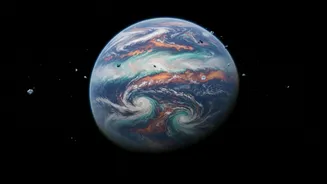
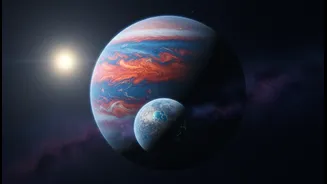
light give it a unique ability to see what other telescopes cannot. While its stunning images of nebulae and galaxies capture the headlines, one of its most revolutionary jobs is to study the worlds orbiting other stars, known as exoplanets. JWST isn’t just looking at these planets; it’s analysing the very air they are made of, hundreds or thousands of light-years from Earth.
The Science of Starlight Filtering
So, how does it 'smell' an atmosphere from so far away? The primary technique is called transmission spectroscopy. It sounds complex, but the idea is simple. Astronomers wait for an exoplanet to pass in front of its host star, an event called a 'transit'. As the starlight travels towards us, a tiny fraction of it filters through the upper layers of the planet’s atmosphere. The gases in that atmosphere absorb very specific colours, or wavelengths, of light. By observing the starlight before, during, and after the transit, JWST can measure the tiny dips in brightness at specific colours.
Decoding an Atmospheric Barcode
Every molecule, from methane to carbon dioxide, has a unique 'fingerprint'—a specific pattern of light that it absorbs. Water vapour is no different. When the filtered starlight reaches JWST's highly sensitive instruments, like the Near-Infrared Spectrograph (NIRSpec), the light is spread out into a spectrum, much like a prism creates a rainbow. This spectrum is effectively a barcode of the planet's atmosphere. Missing slivers of light in this barcode tell scientists exactly what molecules are present. For planets like the hot gas giant WASP-96 b, located 1,150 light-years away, JWST's data revealed the first clear and unambiguous signature of water.
A Clear Signal on Gassy Worlds
The telescope has repeated this feat on numerous gas giants, including ultra-hot planets like WASP-18 b, where temperatures are so extreme they should tear most water molecules apart. The fact that JWST can still detect the subtle signals of the surviving water is a testament to its incredible sensitivity. These observations not only confirm the presence of water but can also provide hints about clouds, haze, and even weather patterns in these alien atmospheres, painting a far more detailed picture than was ever possible before.
Why Find Water on Uninhabitable Planets?
Finding water on scorching-hot gas giants larger than Jupiter might seem odd. After all, these worlds are completely uninhabitable as we know it. However, this is a crucial first step. These large planets with puffy atmospheres are the easiest targets for testing and perfecting the technique of transmission spectroscopy. Confirming water on them proves the method works. Furthermore, understanding the distribution of key ingredients like water across different types of planets helps scientists refine their models of how planetary systems form and evolve. It helps piece together the puzzle of how elements are distributed across the galaxy, which is essential context in the grand search for life.