




The Illusion We All Share
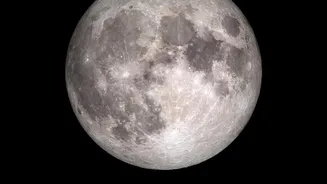
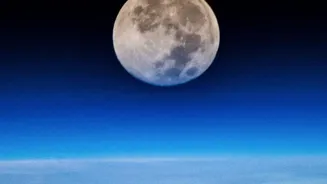
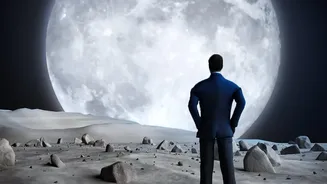
This phenomenon, known for thousands of years, is called the Moon illusion. It's one of the most powerful and convincing optical illusions known to humankind, observed and recorded by cultures across history, including the ancient Greek philosopher Aristotle.
Many people naturally assume the Earth's atmosphere acts like a lens, magnifying the Moon when it's low in the sky. While the atmosphere can change the Moon's color to a more orange or reddish hue by scattering blue light, it does not magnify its size. In fact, photos prove that the Moon's angular size—the space it takes up in your field of view—remains constant whether it's on the horizon or at its peak. The change is happening entirely inside our brains.
Your Brain on the Horizon
So, why does our brain create this illusion? The most widely accepted explanation is a combination of two factors: apparent distance and the Ponzo illusion. The apparent distance hypothesis suggests our brains perceive the sky as a flattened bowl, not a perfect hemisphere. We are used to seeing clouds, birds, and planes overhead as being relatively close, while things on the horizon are understood to be very far away. When the Moon is near the horizon, our brain sees it alongside familiar depth cues like trees, buildings, and mountains. Because we interpret these foreground objects as being far away, our brain assumes the Moon, which appears behind them, must be incredibly distant and therefore enormous.
Meet the Ponzo Illusion
This is where the Ponzo illusion, named after Italian psychologist Mario Ponzo, comes into play. The classic example involves two identical horizontal lines drawn on a pair of converging lines, like railway tracks stretching into the distance. The line drawn 'closer' to the converging point (the 'horizon') appears much longer than the identical line drawn 'closer' to the viewer. Our brain’s logic dictates that if two objects have the same retinal size but one appears farther away, the 'farther' one must be physically larger. When the Moon is on the horizon, the landscape provides those converging lines, tricking our visual processing system into 'scaling up' the Moon's size. When the Moon is high in the empty sky, there are no depth cues to compare it to, so our brain perceives it as closer and, therefore, smaller.
Prove It Yourself With a Ruler
You don't need a high-tech lab to debunk the illusion for yourself. A simple ruler or even your own finger can do the trick. One of the easiest methods is to hold a small object, like the tip of your pinky finger or a pencil eraser, at arm's length. When the Moon is on the horizon and looks gigantic, hold your finger up to it. You’ll find it easily covers the entire lunar disk. Wait a few hours for the Moon to climb higher in the sky, where it appears much smaller. Repeat the experiment. You will discover that your finger still covers the Moon just as easily. Its apparent size hasn't changed at all. Another method involves a ruler and a paperclip. You can hold a yardstick or ruler to your cheek and slide a paperclip along it until the moon fits perfectly inside the clip's loop, then note the distance. When you repeat this with the overhead moon, the measurement will be the same, proving its angular size is constant.
Other Ways to Break the Spell
Beyond rulers and fingers, there are other fun ways to break the illusion. Try rolling a piece of paper into a tube and looking at the horizon Moon through it. This removes the surrounding landscape from your view, and the Moon will instantly appear to shrink. Another famously effective, if slightly silly-looking, method is to turn your back to the Moon, bend over, and look at it upside down from between your legs. This unusual viewing angle disorients your brain's normal perception of the environment, stripping away the contextual cues and allowing you to see the Moon without the illusory size enhancement.