






India's bullet train dream is rapidly becoming a high-speed reality. The first passenger service on the landmark Mumbai-Ahmedabad corridor is set to launch on the Surat-Vapi section, heralding a new chapter in the nation's infrastructure story.
The First Leg of a Landmark Journey
The Mumbai-Ahmedabad
High-Speed Rail (MAHSR) project, a 508-km corridor, is one of India's most ambitious infrastructure undertakings. While the entire route is a monumental task, the project will be opened in phases. The first section scheduled for commercial operation is the stretch connecting the industrial hubs of Surat and Vapi in Gujarat. According to Railway Minister Ashwini Vaishnaw, this inaugural service is targeted to commence in the last quarter of 2027, marking a major milestone that transforms the project from a construction story into a transport reality.
Why This Section Is First
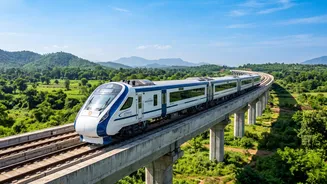
The decision to prioritise the Gujarat portion of the corridor, specifically from Surat to Vapi, was strategic. Progress in this state has been significantly faster, largely due to smoother land acquisition and fewer logistical hurdles compared to the section in Maharashtra. Civil works on this stretch are largely complete, including the construction of elevated viaducts and bridges. A crucial recent development was the energisation of the overhead electrical lines on the 50-km Surat-Bilimora section, a precursor to the full Surat-Vapi rollout, which allows for initial testing to begin. Trial runs on the Surat-Bilimora stretch are expected to start by mid-2027, paving the way for the commercial launch.
Overcoming Delays and Challenges
The bullet train project was first announced with a 2017 groundbreaking, but faced significant headwinds. Railway Minister Ashwini Vaishnaw has noted that full-scale construction only truly began in 2021. The project encountered nearly two-and-a-half years of delays related to state permissions and land acquisition in Maharashtra, compounded by another two-year setback due to the COVID-19 pandemic. Despite these challenges, recent progress has been rapid, with hundreds of kilometres of piers and viaducts now in place across the corridor.
A Glimpse of High-Speed Travel
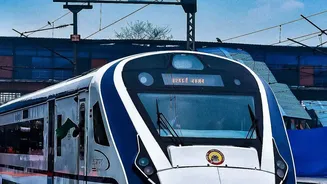
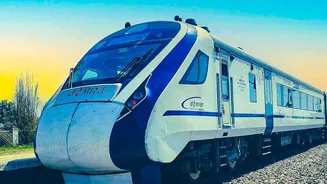
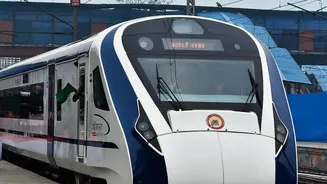
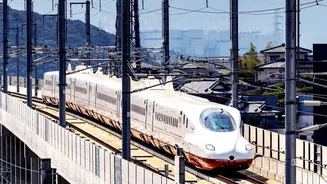
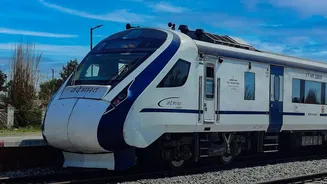
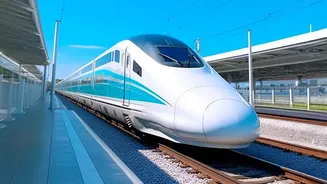
The trains are designed to operate at a speed of 320 km/h, drastically cutting travel time. The full Mumbai to Ahmedabad journey, which can take over eight hours by road, is expected to be completed in just under two hours. The initial trials will use the indigenously manufactured B-28 trainset, designed for speeds up to 280 km/h. These trains, built jointly by the Integral Coach Factory (ICF) and BEML, are a significant achievement for the 'Make in India' initiative. Work is also underway on a more advanced B-35 trainset, designed for speeds of up to 350 km/h.
Engineering Marvels Along the Way
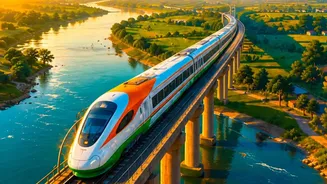
The scale of engineering is immense. The majority of the 508-km corridor is elevated on viaducts to ensure high speeds and eliminate interference from road traffic. The project also includes India's first undersea rail tunnel, a 7-km stretch beneath Thane Creek in Maharashtra, for which massive tunnel boring machines were launched in July 2026. Even the power infrastructure is advanced, using a 2x25 kV overhead traction system common in global high-speed rail networks. Many key components, including transformers and cables, are now being manufactured domestically.
What's Next for the Corridor
Following the Surat-Vapi launch, the corridor will be commissioned in further phases. The next target is to complete the Ahmedabad-Vapi section by the end of 2027. The more complex section in Maharashtra, extending the service to Thane, is expected to be ready by 2029. While the initial launch will be a critical proof-of-concept, the phased rollout demonstrates a pragmatic approach to completing one of the most complex engineering projects in India's history.