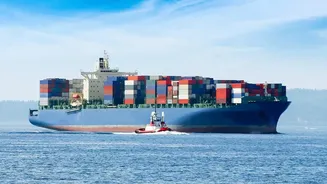




The concept of giant, crewless cargo ships navigating the oceans on their own sounds like science fiction. But researchers at IIT Madras are bringing it closer to reality with SeaNav, a groundbreaking platform designed to make it happen safely.
What is SeaNav?
SeaNav,
short for Sea Navigation, is a state-of-the-art digital twin platform developed by the Department of Ocean Engineering at the Indian Institute of Technology Madras. It's essentially a highly realistic virtual world for ships. Instead of taking an untested, multi-million dollar autonomous vessel into the unpredictable open ocean, developers can use SeaNav to test, validate, and train their self-driving algorithms in a controlled, high-fidelity simulation. The platform can mimic everything from ocean waves and vessel movements to complex port environments and sensor data in real time. This innovation addresses a major hurdle for the global shipping industry: the immense cost, complexity, and potential danger of real-world testing for autonomous navigation systems.
The Challenge of the Open Sea
Testing autonomous technology is risky in any environment, but at sea, the stakes are exponentially higher. A software glitch or sensor failure on a 300-metre-long tanker could be catastrophic, leading to collisions, environmental disasters, and massive financial losses. The open ocean is an unpredictable environment, with changing weather, dense traffic in shipping lanes, and the sheer scale of the vessels making live trials a logistical nightmare. Furthermore, international maritime laws are still catching up to the concept of unmanned ships, creating complex legal and insurance challenges. By providing a risk-free digital playground, SeaNav allows for thousands of hours of testing and refinement of navigation algorithms, ensuring the technology is robust and reliable before it ever touches the water. This dramatically lowers the barrier to entry for innovation in the sector.
How the Digital Twin Works
Built on the powerful Unity3D engine, SeaNav creates a digital replica of the maritime world. It fuses data from multiple sources to simulate a complete operational picture. This includes AI-powered path planning, sensor fusion from virtual RADAR and LiDAR systems, and physics-based models that accurately replicate how a vessel moves in the water. Researchers have calibrated the simulator using a benchmark tanker vessel approximately 320 meters long, ensuring that the results generated in the virtual environment closely mirror real-world commercial shipping operations. This allows developers to test how their autonomous systems handle a wide range of scenarios, from routine docking procedures to complex collision avoidance manoeuvres in crowded waters, all from the safety of the lab.
A Boost for India's Maritime Vision
The development of SeaNav is a significant step for India's ambitions in the maritime sector. The platform aligns perfectly with national initiatives like the 'Sagarmala Programme' and Maritime India Vision 2030, which emphasize the need for smart ports, digital technologies, and autonomous systems to boost efficiency and safety. By fostering indigenous technology, IIT Madras is helping to reduce reliance on foreign expertise and technology, which can generate significant cost savings for the nation. This work is part of a broader effort at the institute, through its Centre of Excellence for Vessels and Unmanned Systems (CoEVUS), to position India as a global leader in maritime technology. The implications go beyond commercial shipping; the multi-vessel simulation capabilities of SeaNav have potential applications in coastal surveillance, search-and rescue operations, and maritime defence.